Subtotal ₹0.00







Email :138
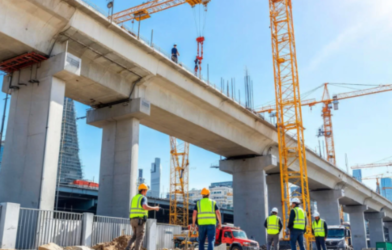
The Union Budget 2026–27 has drawn broad support from the real estate and infrastructure ecosystem for its sustained capital expenditure push, focus on urban infrastructure, and measures aimed at improving project viability and long-term investment confidence. Industry leaders have welcomed initiatives such as higher public capex, development of city economic regions, CPSE asset monetisation through dedicated REITs, infrastructure risk guarantees, and incentives for data centres and Global Capability Centres, citing their potential to unlock growth across Tier I, II and III cities.
However, the Budget has also sparked disappointment over the absence of concrete measures for affordable housing, with developers warning that without urgent policy support, supply constraints could deepen, impacting housing accessibility, rentals and inclusive urban growth.
Dr. Samantak Das, Chief Economist and Head of Research & REIS, India, JLL: “A three-pronged approach that focuses on growth sectors, infrastructure and the services segment has laid down the blueprint to sustain and accelerate economic growth. Specific incentives for biopharma and electronics manufacturing, rare earth mining, setting up education townships & medical value tourism hubs are far-reaching. Additionally, the measures to promote tourism will create accretive employment and revenues while the tax holiday for foreign data centre service providers is set to make India a global hub for data centres. The overall budget is a statement and action document to create the push towards making India a leading manufacturing and innovation-driven ecosystem.”
Shekhar Patel, President, CREDAI National: “CREDAI welcomes the government’s continued focus on infrastructure spending, which is a big positive for the real estate sector. Investments in highways, metros, logistics corridors, railways, and urban infrastructure will improve connectivity, unlock new growth corridors, and support long-term urban development. CREDAI also appreciates the emphasis on ease of doing business. Faster approvals, simplified processes, and greater digitisation can significantly reduce project timelines and holding costs, ultimately benefiting both developers and homebuyers.
However, CREDAI is deeply disappointed that the Budget offers nothing concrete for affordable housing. With the current outdated definition of affordable housing, CREDAI estimates that the segment’s share could decline further from 18% to nearly 12% of total housing supply. This is a serious warning sign for India’s lower middle class and middle class. CREDAI believes that affordable housing is not a welfare scheme — it is economic infrastructure. It is a major driver of employment, consumption, and social stability. Rising construction costs and land prices, without corresponding policy support, are pushing developers away from this segment. If affordable housing supply continues to weaken, the consequences are clear: higher rentals, longer commutes, and growth of informal housing. CREDAI urges the government to give urgent policy attention to affordable housing to ensure inclusive and sustainable urban growth.”
Anil Mittal, Chief Financial Officer, Smartworld Developers: “Budget 2026 lays out a pragmatic roadmap for India’s urban future, anchored in a sustained infrastructure push and clear policy direction that channels long-term investment into major metropolitan markets. In Tier-1 cities, where connectivity, mass mobility and civic infrastructure are key demand drivers, the focus on capex-led growth and regulatory certainty strengthens market confidence and supports sustainable real estate development. As the sector builds enduring urban communities, consistent policy signals and robust infrastructure will remain the foundation for quality housing and long-term value creation.”
Ashish Raheja, Managing director and CEO of Raheja Universal: “The Union Budget 2026 continues the government’s push towards infrastructure-led growth, with a strong capital expenditure commitment of ₹12.2 lakh crore. What stands out for us is the focus on building well-planned cities beyond the metros. The creation of city economic regions, with ₹50,000 crore allocated per region over five years, will significantly improve connectivity and urban infrastructure in Tier II and Tier III markets, opening up new opportunities across residential, commercial and mixed-use developments.
The proposed Infrastructure Risk Guarantee Fund is a practical step that can ease construction-phase risks and encourage greater private investment in large, long-gestation projects. We also see this as a positive signal for the commercial real estate market. The proposed tax holiday for Global Capability Centres (GCCs) is expected to generate demand for large-scale data centres and facilitate local employment. Overall, these measures support the broader vision of Viksit Bharat by helping create more sustainable, liveable and future-ready cities for both developers and homebuyers.”
Nikhil Madan, MD, Mahima Group: “The Union Budget 2026 maintains a largely lukewarm sentiment, but consistent emphasis on capital expenditure as a driver of economic growth encourages hopefulness. With continued allocations toward transport, logistics, urban mobility and regional connectivity, Tier 2 and 3 cities are likely to witness the next phase of real estate development. The commitment to infrastructure led growth for Tier-2 cities is very promising for Jaipur with many existing projects underway such as Jaipur Ring Road, major industrial hubs and sector-specific parks in Rajasthan. In Jaipur, targeted urban infrastructure upgrades and policy continuity are incrementally improving liveability while unlocking new residential and mixed-use development opportunities. As economic activity continues to decentralise and housing demand broadens, the real estate sector stands to benefit from a more diversified and resilient demand base further supporting long-term and sustainable urbanisation rather than a purely cyclical, metro-led growth trajectory.”
Samir Jasuja, Founder and CEO, PropEquity: “The Budget’s emphasis on infrastructure-led growth, development of industrial corridors and manufacturing hubs, data centres, high speed rail corridors, dedicated freight corridor, recycling of significant real estate assets of CPSEs through dedicated REITs, Rs 5000 crore allocation per city economic regions (CER) over 5 years in tier 2&3 cities including temple towns are step towards amplifying the potential of these cities to deliver the economic growth. The consequent impact of this will propel the growth of real estate across categories and pave the way for comprehensive development of the Indian economy.”
Paul Salnikoff, Managing Director and CEO, Executive Centre India Limited: “The Union Budget underscores the government’s continued focus on strengthening urban infrastructure and improving capital access for long-term commercial development. Over the past decade, instruments such as REITs and InvITs have enhanced transparency and institutional participation in India’s real estate ecosystem. The proposed infrastructure risk guarantee fund and calibrated partial credit guarantees further reinforce lender confidence by addressing construction-phase risks. For enterprise-focused workspace providers operating in India’s leading business districts, these measures support the creation of high-quality, professionally managed office environments aligned with evolving occupier expectations. The parallel emphasis on strengthening hospitality and service-led institutions also contributes to building a skilled, customer-centric workforce, supporting sustainable growth across office and workspace platforms.”
Dr. Nitesh Kumar, MD & CEO, Emami Realty Ltd: “The Union Budget 2026-27 presented by Finance Minister Nirmala Sitharaman today marks a significant step forward for India’s real estate sector, emphasizing sustainable growth and infrastructure-led development. The increase in public capital expenditure to ₹12.2 trillion for FY2026-27 will undoubtedly accelerate urban infrastructure projects, creating new opportunities in Tier 1 and Tier 2 cities where demand for quality housing and commercial spaces is surging.
The proposal to establish dedicated Real Estate Investment Trusts (REITs) for recycling significant real estate assets held by Central Public Sector Enterprises is a game-changer, unlocking underutilized land and fostering greater investment in the sector. Additionally, the Infrastructure Risk Guarantee Fund will provide much-needed credit guarantees, reducing risks for lenders and enabling smoother financing for large-scale developments. We are optimistic that these measures will enhance affordability, boost rental housing initiatives, and drive overall sectoral momentum. This budget aligns well with our vision of creating future-ready communities, and we look forward to contributing to India’s Viksit Bharat journey.”
Sandeep Ahuja, Global CEO, Atmosphere Living: “What stands out in Budget 2026–27 is the government’s conviction on public capex, raised to ₹12.2 lakh crore, even as real estate cycles remain selective. The combination of CPSE asset recycling through dedicated REITs, an Infrastructure Risk Guarantee Fund and ₹5,000 crore allocations per City Economic Region over five years directly improves project viability and lender confidence. Improved logistics under the Coastal Cargo Promotion Scheme further supports destination-led hospitality development. On the demand side, simplifying TDS on non-resident property transactions by removing the TAN requirement meaningfully reduces friction for NRI buyers. Together, these measures strengthen capital flow, execution certainty and long-term investability across hospitality-led real estate markets.”
Amrita Gupta, Director of Manglam Group: “Budget 2026 reinforces confidence in India’s real estate growth story. With a sustained focus on infrastructure creation, urban development and housing-led demand, it lays a strong foundation for long-term, planned growth across Tier II and Tier III cities. The emphasis on higher public capital expenditure and strengthening emerging urban centres will significantly improve livability, connectivity and the quality of urban ecosystems. This, in turn, is expected to enhance end-user confidence, support stable housing demand and align well with the evolving aspirations of India’s homebuyers. For developers such as Manglam Group, the Budget provides a positive and enabling outlook for residential growth in emerging cities.”
Binitha Dalal, Founder & Managing Partner, Mt. K Kapital: “Union Budget 2026-27 sends a strong signal of sustained momentum in infrastructure and real estate-led growth, with public capital expenditure proposed at Rs. 12.2 lakh crore for FY 2026-27. This continued capex push will have a direct multiplier effect on construction activity, urban development and employment generation across the economy. The proposed Infrastructure Risk Guarantee Fund is a meaningful step, as it can strengthen lender confidence and reduce financing risks during the development and construction phase of large projects.
What also stands out is the government’s clear push to position India as a global hub for next-generation digital infrastructure. The announcement of a tax holiday until 2047 for foreign cloud companies operating through India-based data centres is a strong move that can attract global technology players while supporting the country’s rapidly rising AI and data demand. This focus on data centres reflects a long-term commitment to building the foundational infrastructure that will power future economic growth.
Equally significant is the announcement of dedicated REITs to accelerate the recycling and monetisation of CPSE real estate assets, opening up new pathways for unlocking institutional capital and improving asset utilisation. Overall, the Budget creates a more supportive environment for long-term investment across both physical and digital infrastructure sectors. Overall it’s a very industry supportive budget given the current dynamic scenario.”