Subtotal ₹0.00






Short Quick Read
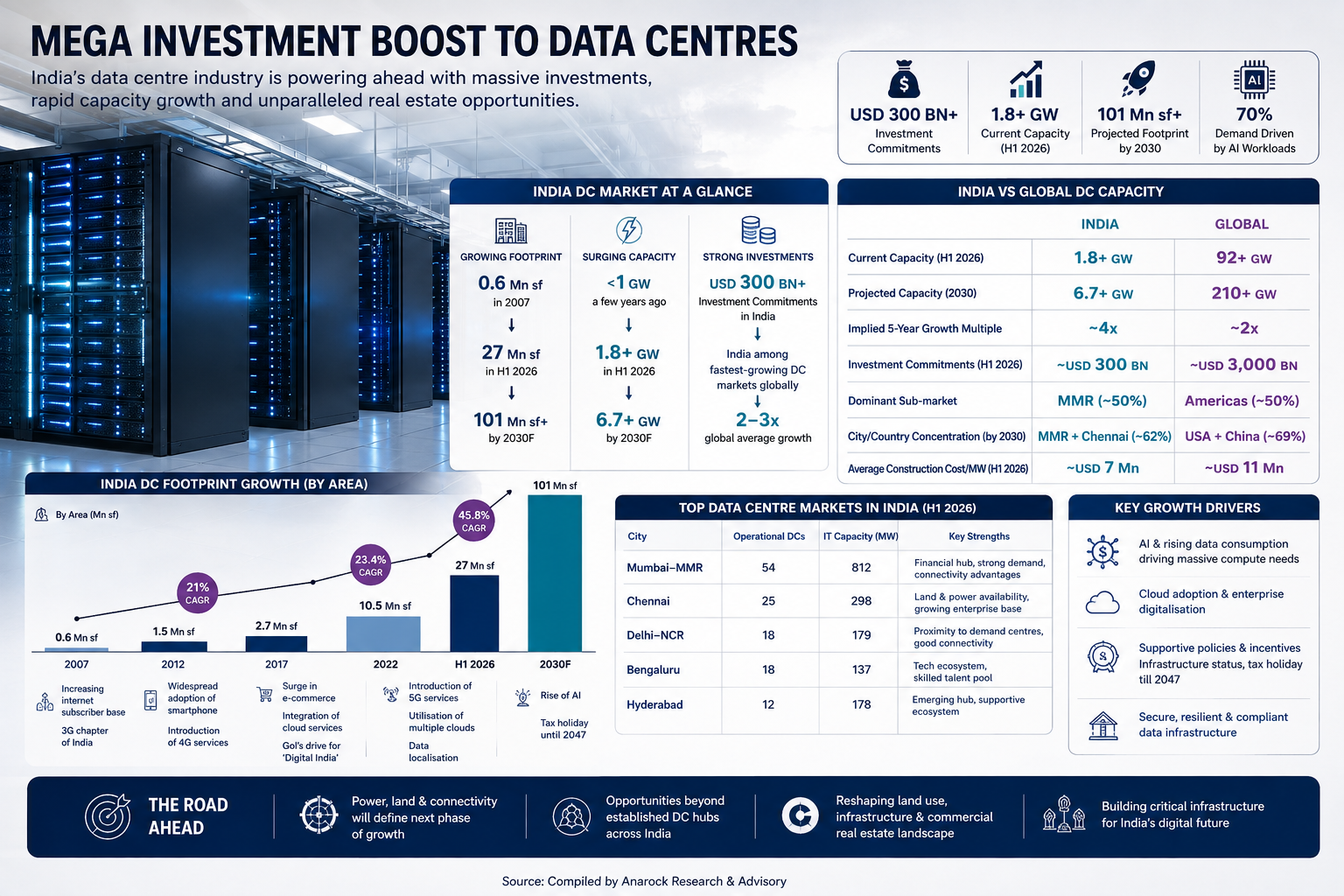
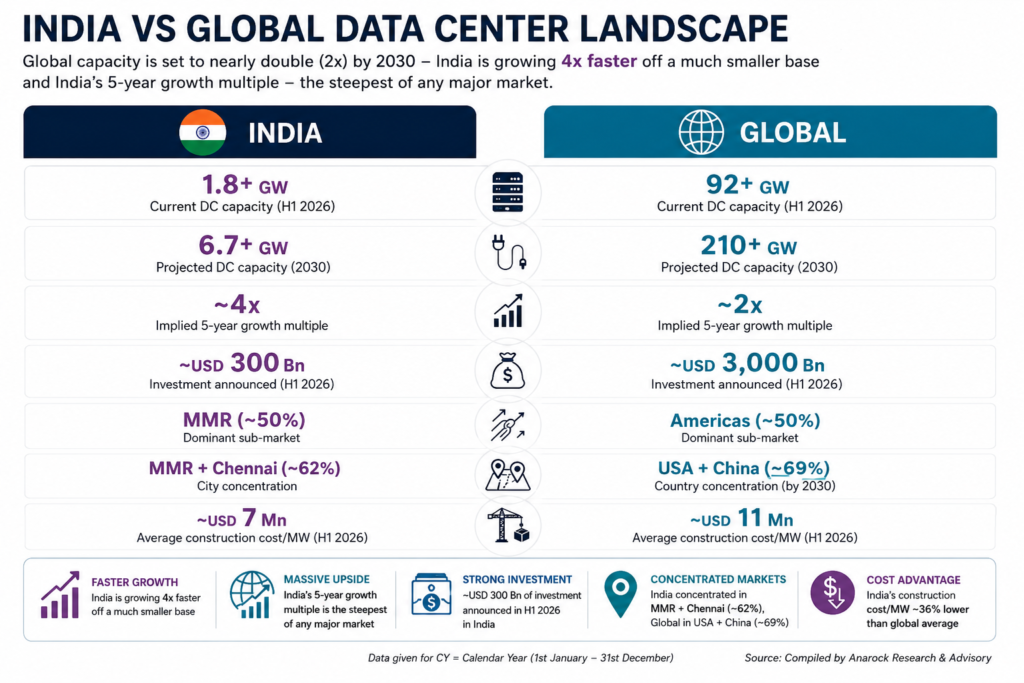
With the USD 300 billion of global investment commitments, India’s data centre industry pegged at 1.8 + GW capacity, is readying for the next phase of growth as one of the fastest growing data centre markets, with MMR as a dominant sub-market, notching up 50% share of the market. By 2030, India’s data centre footprint is set to touch over 101 msf, with 70% of the demand driven by AI workloads, unfolding great real estate opportunities.
Read More…
According to a a latest report of Anarock Capital, from a modest 0.6 msf in 2007, India’s data centre size has touched nearly 27 msf and is all set to top 101 msf in the next four years. This kind of growth, according to Shobhit Agarwal, CEO, Anarock Capital, shows the sheer physical scale of the real estate opportunity. “Unlike conventional office or industrial developments, data centres are highly infrastructure-intensive assets, requiring large land parcels, substantial power capacity, advanced cooling systems, robust connectivity, and high levels of operational resilience. This projected footprint doesn’t represent just additional built-up space requirements – this is a specialised asset class at the intersection of real estate, technology and infrastructure. As operators expand their portfolios, demand for strategically located land, power infrastructure, renewable energy, engineering and construction services, fibre connectivity and specialised cooling solutions will rise in tandem.”
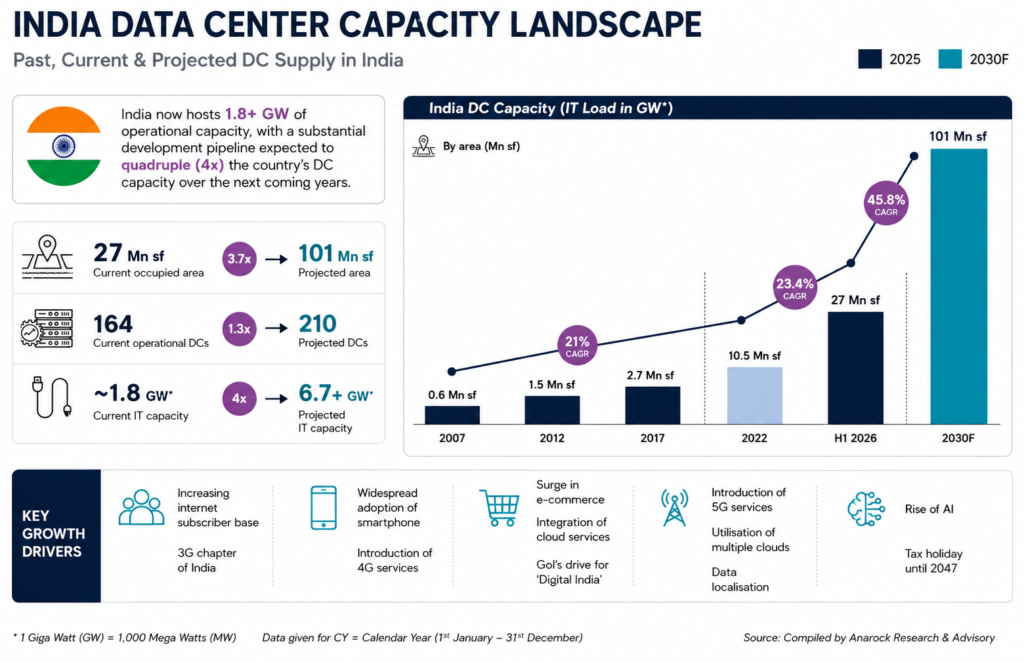
The data centre capacity, as per the report, will also be witnessing high growth. From less than 1 GW only a few years ago, India has crossed 1.8+ GW as of H1 2026. The development pipeline is expected to boost capacity to over 6.7 GW by the end of the decade – a more than threefold increase in the next four years. Supporting this rapid build-out are over USD 300 billion in investment commitments. This positions India among the fastest-growing data centre markets globally, with growth estimated at 2–3 times the global average.
“The massive scale of investment commitments demonstrates the long-term confidence surrounding the sector, and its strategic importance to the digital economy,” says Agarwal. “It also reflects the convergence of multiple structural demand drivers – including cloud adoption, rising data consumption, artificial intelligence (AI), digital payments, enterprise digitalisation and the growing need for secure and resilient digital infrastructure.”
The global DC capacity, in comparison crossed 92+ GW in H1 2026 and is projected to touch 210+ GW by 2030-end – with overall investment commitments of USD 3,000 billion by the first half of that year.
Considering city-wise rankings, Mumbai-MMR remains India’s dominant data centre hub- thanks to its outsized financial and commercial ecosystem, strong enterprise demand, and connectivity advantages. However, the DC market is increasingly expanding across other major digital and business centres, including Chennai, Bengaluru, Delhi-NCR and Hyderabad. These cities are also attracting significant investments. Mumbai-MMR has 54 operational data centres with IT capacity of 812 MW, followed by Chennai with 25 DCs of 298 MW capacity. Delhi-NCR and Bengaluru have 18 centres each with IT capacities of 179 MW and 137 MW respectively. Hyderabad has 12 DCs with IT capacity of 178 MW.
The emergence of these clusters is based squarely on land and power availability, network connectivity, renewable energy access, and proximity to major demand centres. This geographical diversification also opens new opportunities for real estate development beyond established data centre hubs.
AI, with its rapid adoption, is one of the most important drivers of current and future data centre demand, directly impacting the design and engineering requirements of the next generation of facilities. According to Agarwal, AI models require far more computing power, storage capacity and energy than conventional digital applications. As businesses, governments and consumers adopt AI at scale, data centres are evolving from digital activity support to critical infrastructure driving economic growth and technological competitiveness.
On the policy front, the Digital Personal Data Protection Act, 2023 further emphasises the importance of secure domestic data infrastructure, supporting the broader requirement for robust and compliant data management capabilities. The infrastructure status accorded to data centres has also helped improve access to long tenure financing at interest rates of around 9.5-10.5%, for tenures extending up to 12 years. The proposed tax holiday through 2047 for eligible global cloud service providers further enhances India’s competitiveness.
The next phase of data centres growth will be defined by power, land and connectivity. With the projected footprint and capacity growth, and the investment commitments supporting the broader ecosystem, India’s data centre market must scale up at an extraordinary rate. The challenge of ensuring that supporting infrastructure keeps pace with this expansion cannot be under-estimated. Reliable power, suitable land, high-speed connectivity and access to renewable energy will determine where the next generation of data centre capacity can be developed. The data centre opportunity is not just about significant real estate and investment potential – it will eventually reshape land-use patterns, infrastructure investments and the entire commercial real estate landscape across India’s leading digital markets.