Subtotal ₹0.00





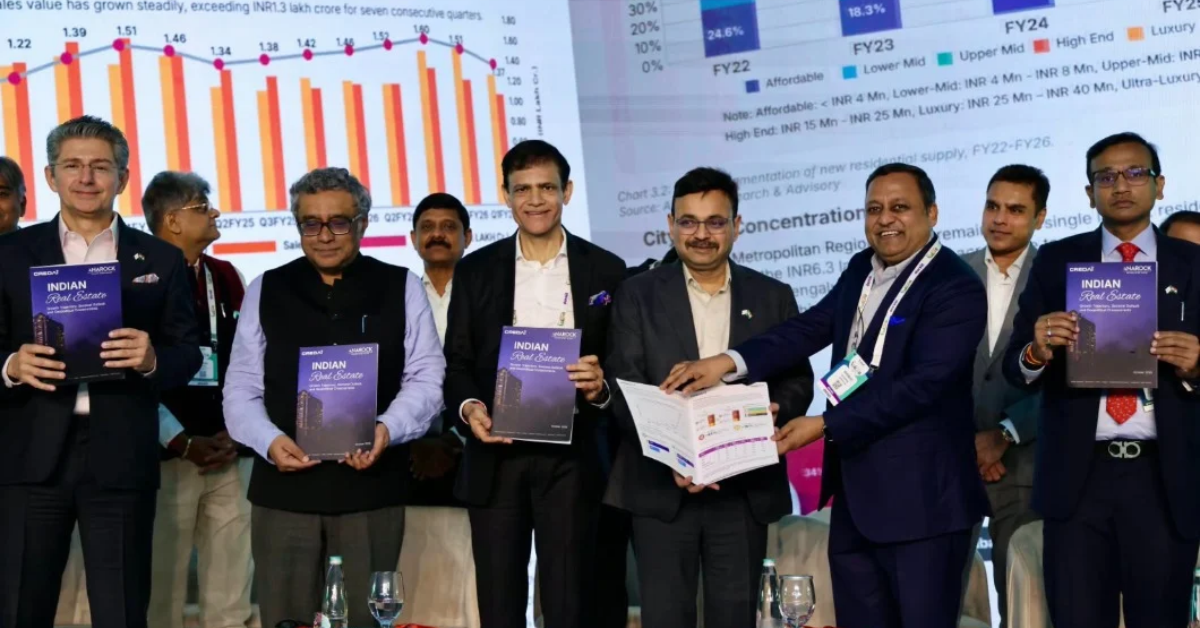

A new CREDAI-ANAROCK report projects the sector to reach $1 trillion by 2030, while NATCON 2026 highlights AI adoption, emerging urban centres and construction workforce training.
The growing role of artificial intelligence (AI), technology and emerging real estate markets in India’s urban growth was a key focus at the 24th edition of NATCON 2026, organised by the Confederation of Real Estate Developers’ Associations of India (CREDAI) in Kolkata. The three-day convention brought together developers, investors, policymakers and industry leaders to discuss the sector’s growth prospects, with a new CREDAI-ANAROCK report projecting the Indian real estate market to reach $1 trillion by 2030.
Technology adoption driven by AI and innovation is increasingly reshaping the real estate sector across the value chain, from sales and marketing to planning, construction, customer engagement and decision-making. AI is enabling sharper market insights, more targeted customer outreach, improved project planning and monitoring, and greater efficiency across operations. The opportunity lies in using innovation not only to improve productivity, but also to transform how real estate businesses engage with customers, make decisions and deliver projects.
The inaugural session of NATCON 2026 was graced by Dr. Swapan Dasgupta, Hon’ble Minister-in-charge, Finance Dept, Govt of West Bengal. Speaking on the occasion, he said, “Kolkata is a city of rich past, but now let’s hope we can have an optimistic future. Kolkata and West Bengal present the greatest opportunity for development in India because we need to upgrade at every level. We are also of the view that impediments to development, such as Urban Land Ceiling, must go. To achieve this, organised developers are needed to build all the mega projects that we have in mind. The state has to realise its true potential. We invite you to come, invest and develop my city and my state.”
CREDAI, in collaboration with ANAROCK Research & Advisory, also launched its latest report, “Indian Real Estate: Growth Trajectory, Sectoral Outlook and Geopolitical Crosscurrents”. The report highlights that the Indian real estate market has grown from USD 120 billion in 2017 to around USD 600 billion in 2025 and is projected to reach USD 1 trillion by 2030 and nearly USD 5.8 trillion by 2047. The total value of real estate under construction has increased more than five-fold, from USD 94 billion in 2009 to USD 503 billion in 2025. Real estate’s contribution to India’s GDP is projected to increase from 6% in 2017 to approximately 13% by 2030, while employment in the sector is expected to reach 30 million by 2030.
The report also points to sustained residential demand, with sales value across the top seven cities rising from Rs. 2.35 lakh crore in FY22 to Rs. 6.10 lakh crore in FY26. Quarterly residential sales have remained above Rs. 1.3 lakh crore for seven consecutive quarters. In office, GCCs accounted for around 45% of leasing in H1 2026, while listed office REITs have expanded their combined leasable area nearly six-fold since FY19. Tier-II and Tier-III cities are also emerging as new centres of real estate activity, alongside the growth of data centres, warehousing and hospitality.
The sector’s focus on building a stronger and more skilled workforce is also reflected in the partnership between CREDAI CSR Foundation and Tata Capital Housing Finance Limited. Under the initiative, around 1,250 construction workers will be trained, contributing to CREDAI’s broader target of training 50,000 construction workers during the current financial year.
“Real estate is entering a phase where technology and innovation will influence every part of the business, from how we understand customers and market projects to how we plan, build and operate them. AI, in particular, has the potential to enable better decision-making, improve efficiencies and create more responsive businesses. For the industry, the opportunity is not simply to adopt new technologies, but to use them meaningfully to build a more productive, transparent and future-ready sector,” said Shekhar G. Patel, President, CREDAI.
“At the same time, the next phase of India’s urban growth will increasingly extend beyond the traditional metropolitan centres. Kolkata, with its economic depth and position as a gateway to eastern India, can play an important role in this transition. As infrastructure and connectivity improve across West Bengal, they can strengthen economic corridors, bring emerging cities into larger development networks and unlock new opportunities for housing, businesses and investment. Bringing NATCON to Kolkata is about focusing the industry’s attention on this opportunity and creating a dialogue on how real estate and infrastructure can together contribute to more connected and competitive cities, in line with the vision of Viksit Bharat,” he further added.
Addressing the gathering, Boman Irani, Chairman, CREDAI, said, “NATCON brings together different parts of the real estate ecosystem and gives the industry an opportunity to look at how the sector is changing. The discussions around technology, sustainability, skills and investment are closely connected to the way real estate will grow in the years ahead. The ANAROCK report provides a useful perspective on this change, from the continued strength of residential demand and office leasing to the growing role of institutional capital and emerging asset classes. The partnership with Tata Capital Housing Finance is equally relevant because the adoption of new technologies has to be accompanied by investment in the skills of the people who will use them.”
The three-day NATCON will see developers, investors, policymakers and other industry stakeholders discuss the issues shaping the sector and the opportunities emerging across Indian cities.