Subtotal ₹0.00


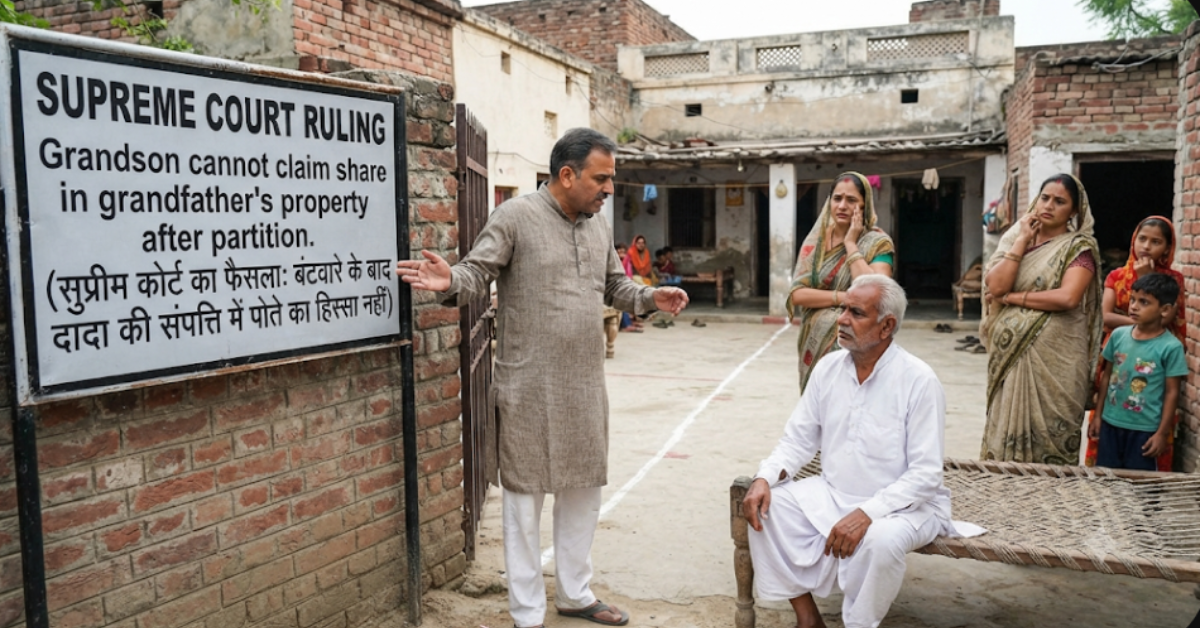

The Supreme Court has ruled that a son cannot claim coparcenary rights in his grandfather’s ancestral property after it has been partitioned among the grandfather’s legal heirs, with the share allotted to his father becoming his exclusive property under the Hindu Succession Act, 1956.
Dismissing a 29-year-old partition suit filed on behalf of a minor son who claimed half of his grandfather’s property, the court held that once the property devolved upon the grandfather’s Class I legal heirs and was divided among them, the joint coparcenary ceased to exist. The grandson could not subsequently claim a share in the property allotted to his father merely on the basis of his birth.
A bench of justices Augustine George Masih and Sunita Agarwal, in a judgment delivered on November 6, held that the property inherited by the father under Section 8 of the Hindu Succession Act became his individual property, leaving no scope for his son to assert an independent coparcenary interest in it.
“The property of grandfather of the appellant devolved upon the Class I heirs in the order of succession specified therein, and they shall take the property simultaneously to the exclusion of all other heirs,” Justice Agarwal, who authored the judgment, said.
Under the 1956 Act, Class I heirs include a deceased Hindu male’s widow, son, daughter and mother who inherit the property simultaneously, ahead of all other categories of heirs.
The case originated in 1997 when the appellant, the grandson, was still a minor and his mother, acting as his natural guardian, filed a suit seeking partition and possession of half of a 1,811-square-foot property in Chennai. He claimed that the property originally belonged to his grandfather and that he had acquired a coparcenary interest in it by birth.
However, the property had already been divided among his grandfather’s legal heirs following a partition suit instituted in 1993 by the appellant’s paternal aunt. A compromise decree was passed on February 3, 1994, under which the appellant’s father, who was one of the legal heirs, received a share measuring 1,811 square feet. He subsequently sold the property through two sale deeds executed in April 1997.
The appellant, who was born in January 1994, contended that since the compromise decree was passed after his birth, he had already acquired coparcenary rights in the ancestral property and should have been made a party to the partition proceedings. He also relied on the Tamil Nadu amendment to the Hindu Succession Act, which recognised daughters as coparceners by birth, arguing that the amendment preserved the coparcenary character of the property.