Subtotal ₹0.00






Email :50
Budget fails to bridge luxury- affordable housing divide
In the absence of a direct boost to real estate, especially beleaguered affordable housing, the infra-friendly budget and the reform push, will help sustain real estate growth momentum.
Vinod Behl
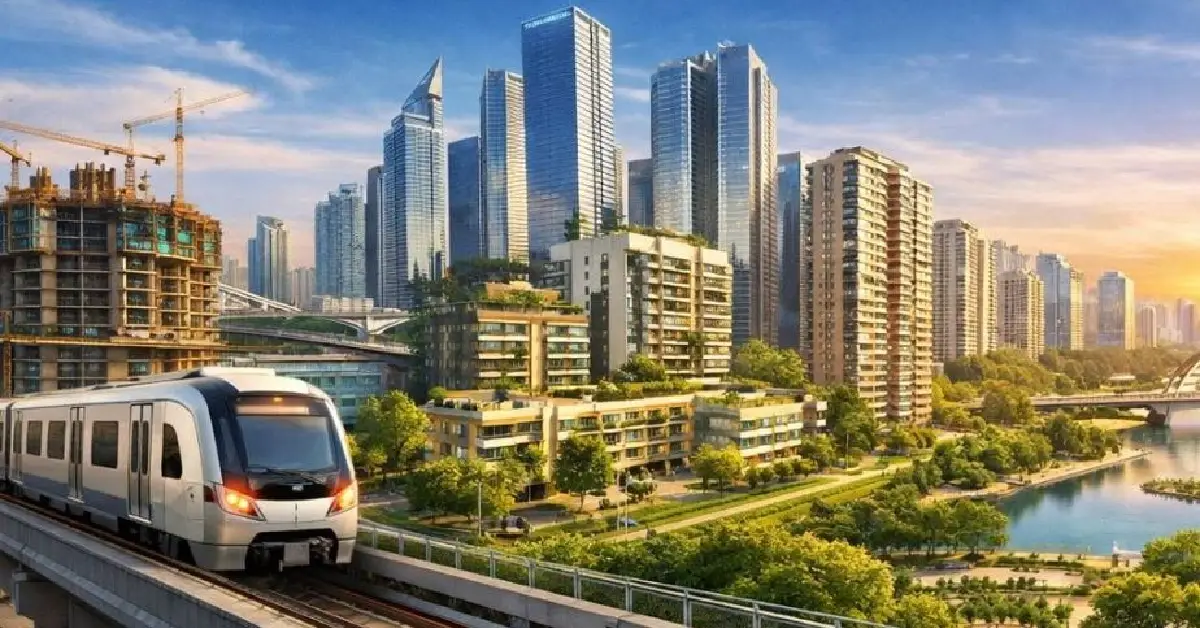
Considering that infrastructure is the backbone of real estate, the Union Budget for FY 2026-27, has continued its capex push with an enhanced outlay of 12.2 lakh crore to trigger states spending and boost private investment. The budget also focuses on generating funds for infrastructure development through asset monetization. There is a significant proposal to accelerate the recycling of real estate assets held by CPSEs through the creation of dedicated rights structures while improving the productive use of existing land and built assets targeting INR 10 lakh crore assets among railway properties. There is also a provision for recycling of CPSE real estate assets through dedicated REITs and continued emphasis on Invites. Additionally, the Finance Ministry has lined up INR 17 lakh crore infra projects for PPP over 3 years.
The budgetary provision for Infrastructure[PP1] Risk Guarantee Fund offering public credit guarantees to lenders, will address the long-standing concern around project financing risks faced by developers. It will help ease developers’ access to capital and improve credit flow to ensure their project execution capabilities. Significantly, projects worth INR 85 lakh crore spanning roads, railways, power airports and urban infra are accelerated under the Centre’s flagship PRAGATI platform.
The mega push to infrastructure development will also provide connectivity boost to real estate as INR 3 lakh crore and INR 2.77 lakh crore budget outlay has been provided to the road sector and railways respectively. The budget has announced new dedicated freight corridors and 20 new national waterways over the next 5 years. It makes a provision for 7 high speed rail corridors.
The funding boost to Tier-2 and Tier-3 cities, through the creation of City Economic Regions, will help boost real estate in these cities through connectivity push. This budget initiative comes after the government unveiled a INR 1 lakh crore Urban Challenge Fund for creative redevelopment of cities. Moreover, the 16th Finance Commission has more than doubled the grant for Urban Local Bodies (ULBs) to INR 356257 crore for 2026-31, from INR 155000 crore for 2021-26. This will not just bolster urban development, but also boost the quality of life.
The budgetary push to Tier2-3 cities and doing away with GCC tax ambiguity, will considerably aid the growth of commercial real estate, besides augmenting residential realty. Real estate developers will be encouraged to set up satellite offices and GCC centres in these emerging cities because of lower land costs and availability of talent pool. According to a recent FICCI-Anarock report, India is set to host 2400 GCCs by 2030 with a market size of USD 105-110 billion, resulting in the expansion of Grade A office stock beyond 800 msf . In 2025, GCCs accounted for over 32.5 msf of total gross office leasing out of 80.5 msf of total office leasing.
The FY 27 budget provides a booster dose to Alternate Realty, with a special focus on Industrial & Logistics (I&L). In a boost to industrial realty, the budget has increased the allocation for electronics component manufacturing scheme from INR 22k crore to INR 40k crore. The Semiconductor Mission Phase-2 outlay will exceed INR 76k crore. Besides, there is a scheme to revive 200 legacy industrial clusters. Notably, earlier the government had approved the development of 12 new industrial smart cities with an outlay of INR 28602 crore. The policy push in the form of tax holiday for foreign cloud service providers till 2047, and safe harbour reform easing transfer pricing and tax issues, will give a big boost to data centres which are expected to net USD 200 billion of investments. The budget scheme to support states establish 5 regional medical hubs in partnerships with private sector and push to medical tourism will help aid the growth of health realty. Similarly, Education Realty will also see upsurge with budgetary provision to set up 5 varisty townships in each district in the vicinity of industrial and logistics corridors.
The boost to sustainable real estate through INR 20k crore budgetary allocation over 5 years for scaling Carbon Capture Utilization & storage (CCUS) , will encourage developers to use CCUS produced materials to achieve improved ESG ratings. This will not only help source institutional capital but also lead to premium pricing in the residential, commercial and hospitality segments.
Notwithstanding all these positives, the budget is a big dampener for affordable housing, belying the hopes of real estate developers and homebuyers to revive this crucial segment. The unaffordable prices and growing mismatch between demand and supply has dashed the hopes of middle and lower middle-class people aspring to own a house. A recent Magicbricks study showing that homes below INR 75 lakh drive 43% of demand but make up for just 17% of the supply is a clear pointer. Supply remains skewed towards higher ticket sizes despite strong demand at lower price points due to rising land prices and construction costs and developers’ focus on premium and upper-mid-segments where margins are higher. This is clearly evident as new residential launches in this quarter were largely concentrated in higher price brackets, particularly in INR 1.5-3 crore bracket.
As a consequence of this, affordable housing sales have been continuously on decline, falling from 38% in 2019 to mere 18% in 2025. The apex body of developers-Credai has cautioned that this share may further fall to 12% as the budget has not addressed the issue of unrealistic price cap of affordable homes at INR 45 lakh and tackling demand and supply side constraints through tax relief to affordable housing homebuyers. Clearly, there is an urgent case for addressing this demand -supply imbalance in affordable housing. There is also an urgent need to boost rental housing to revive affordable housing. However, there is a renewed policy thrust on Pradhan Mantri Awas Yojana (PMAY)-Urban, in the form of more than doubling of outlay for FY 27, from INR 7500 crore to INR 18625 crore. Further, aligning the new IT Act with the existing one, the budget has proposed that pre-construction period interest on housing loans will qualify for deduction from the house property income. These policy interventions are expected to improve affordability and credit uptake in affordable housing.
Further, the timing of the finalisation of India-US tariff deal -almost coinciding with the budget, will serve as a booster for economy in general and the real estate in particular as the real estate sector is a major contributor to country’s GDP. The budget projects a steady 7.6% GDP growth for FY 2026-27, matching FY 2025-26 growth. India’s Chief Economic Advisor V Nageswaran expects that the Economic Survey prediction of 6.8- 7.2% GDP growth in FY 2026-27, down from 7.4% this year , is likely to undergo an upward revision. And even if the RBI takes a pause on rate cut in February due to rising inflation and slower growth, there’s a scope for further rate cuts in the next financial year in the light of a booster dose provided by the Trump tariff deal. This favourable development, together with a largely positive budget should lay a beneficial pathway for the real estate sector in 2026.