Subtotal ₹0.00






Email :71
India’s retail real estate sector scaled a three-year high in 2025, recording a sharp 54% year-on-year jump in gross leasing activity, according to a report by JLL. After a brief moderation in 2024, leasing momentum rebounded strongly on the back of resilient economic fundamentals, rising discretionary spending, and aggressive expansion by domestic and global retailers across key metropolitan markets. Robust supply additions, growing preference for organized retail formats, and increasing participation by D2C and foreign brands further reinforced the sector’s renewed growth trajectory, positioning 2025 as a defining year for India’s retail real estate landscape.
Following robust performance of 8.7 million sq. ft in 2023, leasing volumes moderated to 8.1 million sq. ft by end-2024. However, this trajectory reversed dramatically as 2025 delivered exceptional 54% year-on-year growth in gross leasing volume. This surge reflects unwavering retailer confidence across key metropolitan markets and aggressive expansion strategies, as India redefines its consumption narrative against an uncertain global backdrop. A resilient economy coupled with rising discretionary spending is fuelling this leasing renaissance, with offline retail formats witnessing an influx of premium brands commanding strong consumer loyalty.
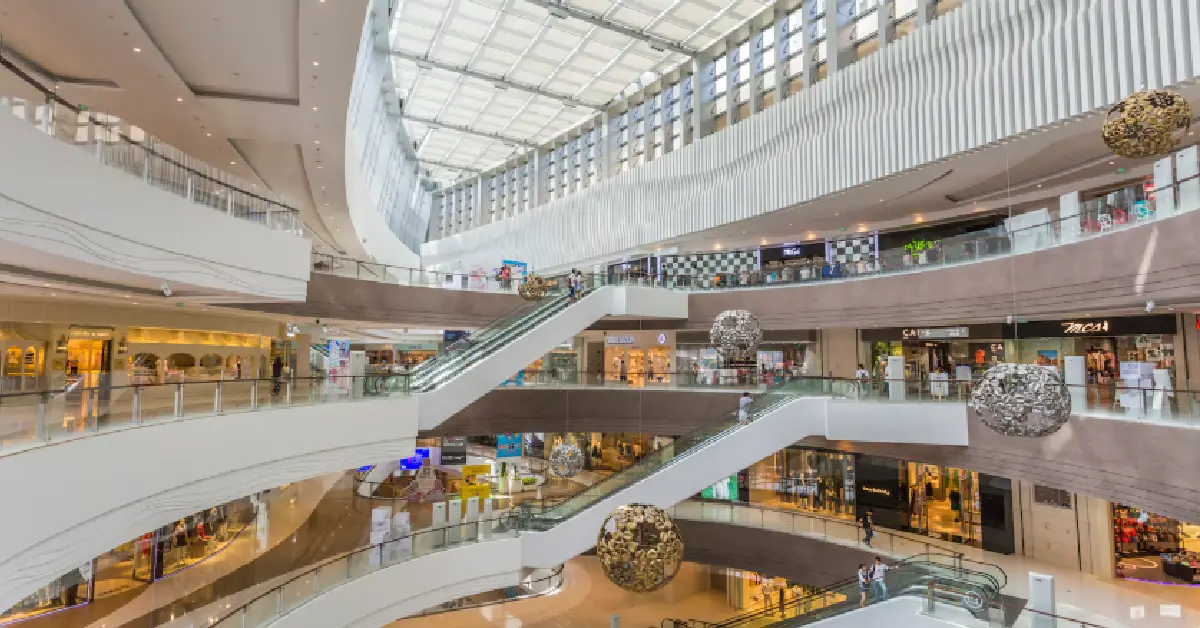
India’s retail sector maintains its robust growth trajectory, driven by substantial supply additions of 6.3 million sq. ft that have facilitated aggressive retailer expansion. This supply surge was pivotal in enabling 2025’s gross leasing volume to exceed the previous year’s total. During 2025, Delhi NCR, Hyderabad, and Mumbai witnessed the launch of 15 shopping malls, collectively contributing to the nation’s overall mall inventory. As of end of 2025, the mall stock in the top seven cities stood at nearly 92 million square feet. The availability of premium institutional-grade mall space encouraged retailers to accelerate store launches in prime locations. Shopping malls captured 45% of the total leasing activity in 2025, while high streets commanded a dominant 48% share.
Leading urban markets drive 2025 retail expansion
Among India’s top seven cities, Delhi NCR, Bengaluru, and Hyderabad emerged as the dominant forces behind 2025’s gross leasing surge. Delhi NCR and Bengaluru each captured 24% of the total leasing volume, with Hyderabad closely following at 23%. Mumbai secured a 17% market share, while Kolkata (5%), Chennai (5%), and Pune (2%) registered modest single-digit contributions as retail leasing remained constrained by limited new supply and minimal brand entry activity.
Shopping malls commanded the largest share of gross leasing activity in Delhi NCR and Hyderabad, whereas high street locations attracted significant retailer interest for expansion in Bengaluru.
“While fashion & apparel (34%) and food & beverage (20%) together comprised more than half of the annual leasing, the share of Fashion and Apparel has moderated from 41% in 2023 to 34% in 2025 though it still retains the top slot due to demand emanating from renowned domestic and D2C brands. During the same horizon of three years, it is F&B that has gained in share from 16% in 2023 to 20% in 2025, emerging as a clear winner in terms of redefining retail space requirements. Another interesting trend that became more pronounced during the year was the direct-to-consumer (D2C) brands going full throttle in terms of setting up physical store footprint garnering 0.9 million sq. ft of gross leasing volume. There is a substantial 48% annual growth in leasing by D2C brands in India fuelled by categories such as fashion and apparel, jewellery and beauty, cosmetics and wellness,” said Dr Samantak Das, Chief Economist and Head of Research and REIS, India, JLL.
“Demand from domestic retailers continued to accelerate as they accounted for 82% of 2025’s gross leasing activities. High streets as well as shopping malls witnessed vibrant demand from domestic retailers for large sized stores in the year. From 6.5 million sq. ft of leasing in 2024, the retail space take-up by indigenous brands exceeded more than 10 million sq. ft. in 2025. While the domestic retail growth story remains strong, foreign brands are not too far behind. Retail spaces leased by foreign brands experienced a 36% y-o-y growth in 2025. As many as 29 new foreign brands entered India during the year, the highest in the past five years. Leading names such as Bershka, Nespresso, COS, Lego and NEXT came to India in 2025.The structural strength of India’s retail sector coupled with rising brand awareness will aid the entry of more foreign players in years to come,” said Rahul Arora, Head – Office Leasing & Retail Services, Senior Managing Director (Karnataka, Kerala), India, JLL.
Setting the stage for a new high
The boom in retail leasing in 2025 is not a short-term trend but an indication of a structural shift backed by growing preference for organized retail, quality retail infrastructure and increased institutional play in management of shopping malls. Currently, superior quality stock (institutionally owned and/or premium single ownership) of 40 million sq. ft is around 44% of total retail mall stock across the top seven cities. Additionally, there is a strong pipeline of more than 47 million sq. ft of shopping malls under various stages of construction which are likely to be operational in the top 7 cities by 2030. In this total upcoming supply, superior quality mall space is 20 million sq. ft (~43%).
With fast evolving consumer preferences and increasing consumption spends, developers will need to keep pace and incorporate tech, hospitality and experience related elements at the construction stage for the development pipeline to be future ready. With strong economic fundamentals and premiumisation, demand for retail spaces will continue to heighten. Indian retail sector has witnessed USD 2.3 billion institutional investment during the last 5 years. Going forward, it is only the future ready retail assets that will attract more institutional capital.