Subtotal ₹0.00






Email :33
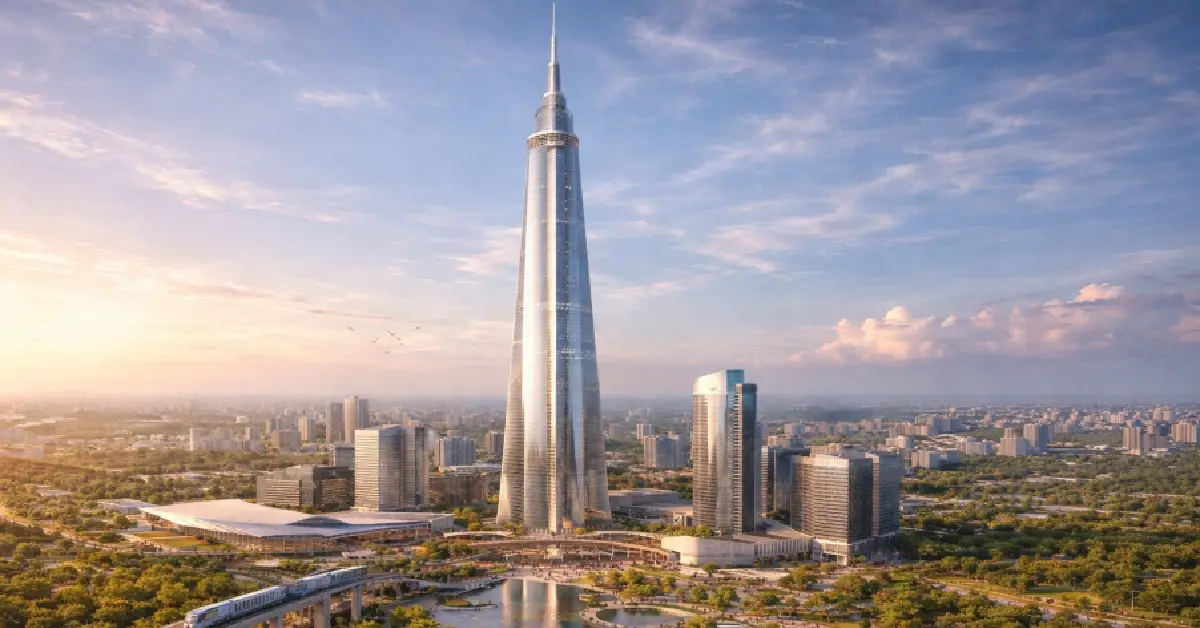
The Haryana government has unveiled plans to construct India’s tallest building as the signature landmark of its ambitious 1,000-acre Global City project along the Dwarka Expressway near Gurugram. Currently at the proposal and Request for Proposal (RFP) stage, the project is yet to enter the bidding phase, with consultancy support also under consideration, state cabinet minister Rao Narbir Singh said.
The proposed iconic tower, envisioned to rise higher than any existing structure in the country, is being planned as a mixed-use landmark, housing premium office spaces, global corporate headquarters, hospitality, observation decks and public spaces, according to a report by The Hindustan Times.
Officials said the building is intended to serve not just as a commercial hub but also as a global symbol of Haryana’s economic ambition and urban transformation, comparable with international skylines in Singapore, Dubai and major European cities.
Speaking on the project roadmap, Singh said the concept of the tallest building is integral to positioning Global City as a global destination.
“We want Global City to be recognised internationally. The proposal for India’s tallest building is part of that vision. However, the project is still under process. The RFP has been proposed, no bidder has been finalised yet, and consultancy support is under consideration,” the minister said, adding that the government is proceeding in a phased and structured manner.
Spread across 1,000 acres on the Dwarka Expressway, the Global City project is envisioned as a large mixed land-use development integrating residential, commercial, institutional, sports and leisure components. Once completed, it is expected to emerge as a major financial and innovation hub of the National Capital Region (NCR), with the tallest building acting as its visual and economic anchor.
According to planning documents, the city will support a residential population of nearly 1.8 lakh citizens, along with a floating population of around 5.2 lakh people, driven by large-scale employment and business activity.
The project has been designed around sustainable and people-centric mobility. Internal transport modes will include Light Rapid Transit (LRT), electric buses, pedestrian walkways and dedicated cycling tracks. Most daily needs—schools and colleges, office spaces, multi-speciality hospitals, retail hubs, bus depots, fuel stations, EV charging stations, fire stations, exhibition and convention centres, and a multi-sports complex—are planned within a 15-minute walking radius.
More than 56% of the total area has been earmarked as open and green space, with plans to plant over one lakh trees. Officials said the project is expected to reduce surface runoff by 55% compared to dense urban areas and lower local temperatures by up to five degrees Celsius, helping maintain a favourable microclimate and acting as a carbon sink.
Green corridors, green streets, grass pavers and no-vehicle zones will define the internal layout, while buildings will be aligned to LEED, GRIHA and IGBC green standards. Renewable energy solutions such as solar-panel-shaded parking, solar street lights, rooftop solar PV systems, smart metering and bio-waste reuse have been integrated into the master plan.