Subtotal ₹0.00






Email :38
Prime Minister Narendra Modi on Sunday inaugurated over 2,700 newly constructed government flats and key office infrastructure in Delhi, while laying the foundation stone for more than 6,600 additional General Pool Residential Accommodation (GPRA) flats and the Bharat Business Park office towers. The projects are part of the redevelopment of seven GPRA colonies in the national capital, being implemented by NBCC (India) Limited and the Central Public Works Department, with the overall programme aimed at creating over 21,000 modern government housing units with an estimated investment of around ₹32,000 crore.
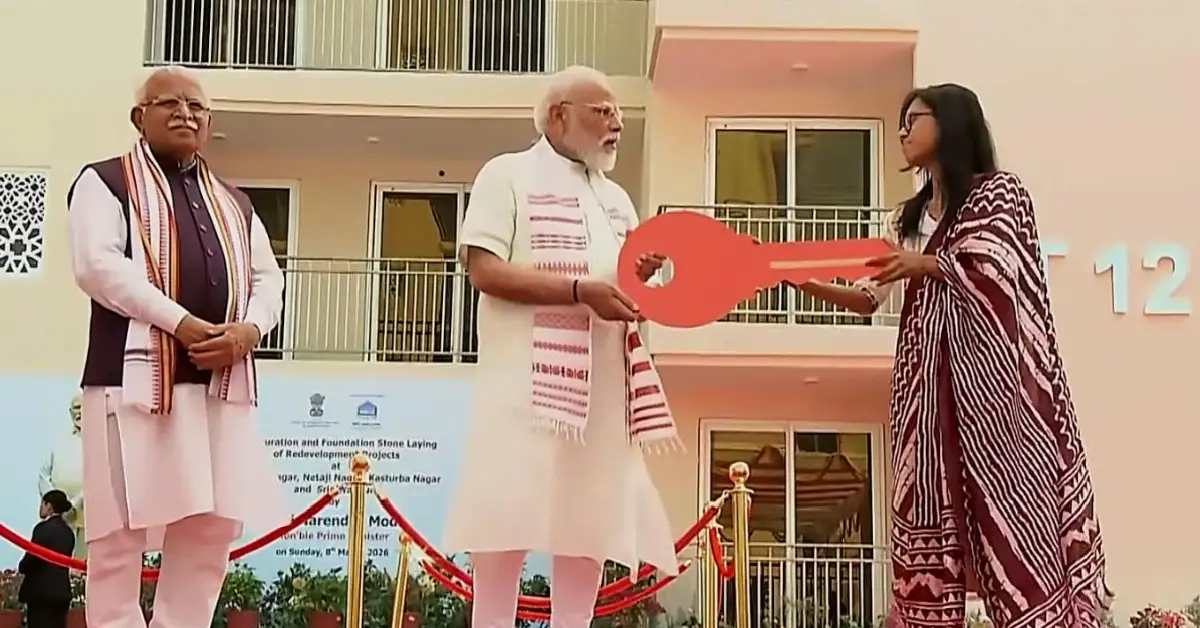
The Prime Minister, prior to inaugurating the projects, visited the GPRA site at Sarojini Nagar along with Manohar Lal, Minister of Housing & Urban Affairs and Power, and Srinivas Katikithala, Secretary, Housing & Urban Affairs. He was briefed about the GPRA project at site by NBCC women officers. Later he met with women shramjeevis working in the project and handed over allotment keys to a few women allotees.
After the site visit, the formal inauguration and foundation laying of the 7 GPRA projects was done by the Prime Minister through virtual mode from Burari, Delhi in the august presence of Manohar Lal, Minister of Housing & Urban Affairs and Power, Vinai Kumar Saxena , Hon’ble Lieutenant Governor of Delhi, Rekha Gupta, Hon’ble Chief Minister, Govt. of National Capital Territory of Delhi (GNCTD), Tokhan Sahu, Hon’ble MoS of Housing & Urban Affairs and other dignitaries.
The redevelopment programme, approved by the Union Cabinet on 5 July 2016, is being implemented by NBCC (India) Limited, Navratna PSU and the CPWD with the objective of creating modern, sustainable government housing and optimising land use in the national capital.
The colonies being redeveloped include Mohammadpur, Thyagraj Nagar, Kasturba Nagar, Sriniwaspuri, Nauroji Nagar, Sarojini Nagar and Netaji Nagar.
Of these, three colonies— Sarojini Nagar, Netaji Nagar and Nauroji Nagar—are being implemented by NBCC, while CPWD is implementing redevelopment in Kasturba Nagar, Thyagraj Nagar, Sriniwaspuri and Mohammadpur. The redevelopment of 7 GPRA colonies is expected to result in a total BUA of 65.42 lakh sqm approximately. NBCC has already completed the re-development of Nauroji Nagar by completing World Trade Center which was inaugurated in January 2025.
The Prime Minister inaugurated GPRA Quarters at Sarojini Nagar and Kasturba Nagar, New Delhi and three towers of General Pool Office Accommodation at Netaji Nagar, New Delhi. These inaugurated projects will add over 2,700 modern residential units and key office infrastructure to the government housing and office pool. In addition to the inauguration foundation stone of more than 6600 GPRA flats across Netaji Nagar, Sarojini Nagar, Sriniwaspuri and Kasturba Nagar and 8 Towers of Bharat Business Park in Sarojini Nagar was also laid.
Bharat Business Park in Sarojini Nagar, New Delhi, developed by NBCC (India) Limited, is a modern commercial office complex designed to provide world-class office infrastructure with sustainable and energy-efficient features. The project comprises a total built-up area of approximately 2.17 lakh square metres of commercial office space, developed to meet contemporary standards of workplace functionality, safety, and sustainability.
The complex will be equipped with centralised air-conditioning supported by energy-efficient chillers and an intelligent Building Management System (BMS) to ensure efficient operation and monitoring of building services. Advanced safety and security features, including fire detection systems, public address systems and integrated CCTV surveillance will also be incorporated. The facility will provide 100 percent power backup through DG sets and UPS systems, ensuring uninterrupted operations for occupants. In line with sustainable development practices, the project shall include solar rooftop panels, energy monitoring systems, EV charging facilities, and 17 nos. rainwater harvesting recharge pits. The building is designed to be GRIHA compliant, reflecting adherence to green building standards. Additionally, the complex features three-level basement parking with capacity to accommodate more than 2,800 vehicles, offering ample parking infrastructure for occupants and visitors. The estimated project value of Bharat Business Park will be around ₹2,270 crore, making it one of the significant commercial infrastructure developments undertaken by NBCC in the national capital.
It is pertinent to mention that NBCC has been at the forefront of redevelopment model. The journey of government housing redevelopment began with successful projects of New Motibagh and East Kidwai Nagar.
The GPRA redevelopment programme follows an innovative self-sustainable redevelopment model by NBCC. Under this approach, ageing government colonies are redeveloped into modern residential complexes, commercial assets are monetized and the revenue generated finances the redevelopment. This model enables large-scale redevelopment without additional burden on the Government budget and provides a framework that can be replicated in other cities across India. NBCC is generating funds for the Government of India for completing all the 7 GPRA Projects including those executed by CPWD.
The redevelopment of the 7 GPRA colonies is progressing steadily with substantial construction and financial progress achieved so far. Till date, more than 25 lakh sqm of BUA has already been achieved across all 7 colonies.
The redevelopment programme till date has also generated 3.55 crore man-days of employment, across 7 colonies with NBCC generating more than 3 crore man-days of employment in its three allocated colonies. Among the colonies, Sarojini Nagar, executed by NBCC accounts for the largest share of redevelopment, followed by Netaji Nagar and Kasturba Nagar, reflecting the extensive residential and commercial infrastructure being created under the programme. The redevelopment of GPRA colonies represents one of the largest urban redevelopment initiatives undertaken in the national capital, contributing to modern government housing, improved urban infrastructure, employment generation and substantial revenue to the government exchequer, while catalysing growth in the construction and allied sectors.