Subtotal ₹0.00






Email :49
Short Quick Read
A widening chasm between the physical cost of building a home and its final market price is fuelling a severe housing affordability crisis. This lopsided inflation results in buyers being priced out of the market while developers face intense margin pressures due to escalating land prices. The residential construction cost went up by 34% while housing prices rose 59% during the past 5 years. The land cost escalated by 50-120% between 2021 H1 2026.
Read More…
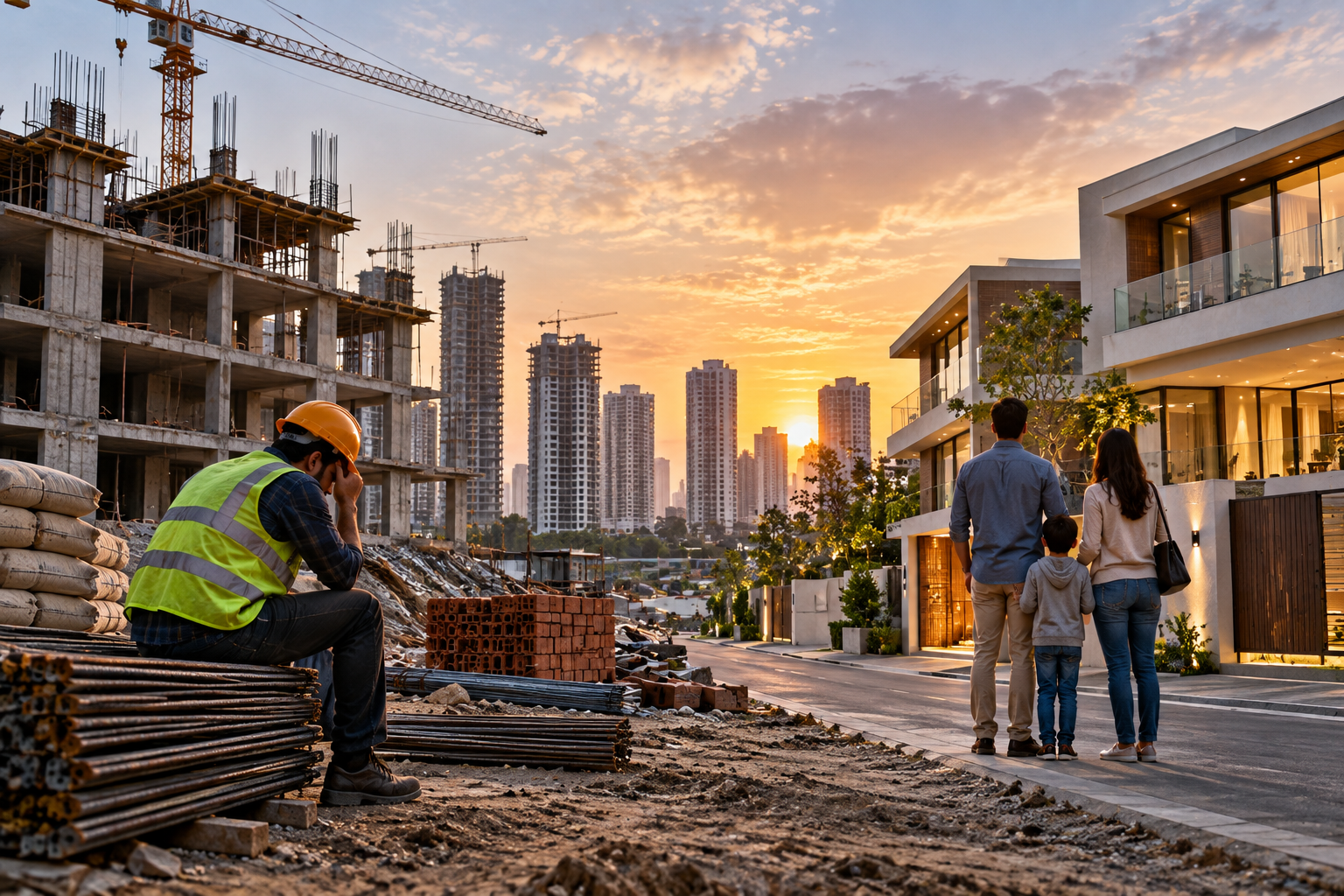
Housing prices across India’s top 7 cities have skyrocketed twice as fast as construction costs over the last five years. This staggering 25% divergence signals an urgent affordability crisis for buyers and a severe margin threat for developers.
There is a clear, widening disconnect between the physical cost of building homes and the final price tag for buyers.
According to a latest Anarock Research report, between 2021 and 2025, the average cost to construct a standard-plus residential project increased by 34% (a 6.9% CAGR), moving from INR 2,681/sft to INR 3,604/sft.In the same period, average residential capital values surged by 59% (a 12% CAGR), jumping from INR 5,826/sft to INR 9,260/sft. As much as 66% of this price hike is linked to construction expenses – the remaining 34% is driven by external pressures, primarily escalating land costs, developer margins, and shifting market demand-supply dynamics. As per Santhosh Kumar, Vice Chairman, Anarock Group, the middle east crisis has added another 8-10% to overall construction costs and developers are now challenged on passing this on to homebuyers without affecting affordability and sales momentum.
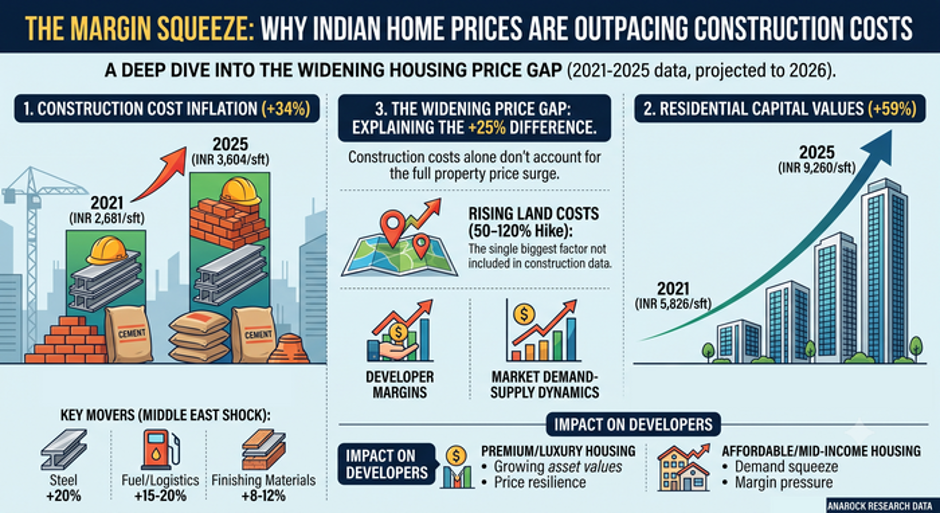
The research data from Anarock for 7 top cities shows a clear divergence between the cost of building homes and the prices at which they are sold. Construction costs have risen by over 34% between 2021 and 2025 – equivalent to a CAGR of nearly 6.9%, while average residential capital values increased 59% – a CAGR of approx. 12%.
| Metric | 2021 (INR/Sft) | 2025 (INR/Sft) | % Change | CAGR |
| Top 7 cities avg. construction cost | 2,681 | 3,604 | 34% | 6.9% |
| Premium-segment construction cost | 3,861 | 5,370 | 39% | 7.8% |
| Residential capital pricing (selling price) | 5,826 | 9,260 | 59% | 12% |
Barring some outliers, land values in the top 7 cities rose between 50% and 120% between 2021 to H1 2026. NCR and Bengaluru saw the highest land price hikes of 70-130% and 60-120%, respectively, in this period. Higher land acquisition costs complicate both project feasibility and home pricing – especially in established corridors, where infrastructure improvements cause land values to rise steeply even before a project’s launch. Within the Middle Eastern war-induced 8-10% construction costs hike, steel and fuel-linked logistics are the sharpest movers. MEP and finishing materials have also recorded significant increases.
| Cost component | Share of cost | Escalation | What is driving it |
| Labour | 25-30% | +5-6% | New labour codes & shortage of skilled workers |
| Finishing (tiles, glass, hardware) | 18-22% | +8-12% | Pricier imports due to shipments reroutes around Cape of Good Hope |
| Steel (TMT) | 15-20% | +20% | Prices up to approx. INR 72,000/tonne |
| Cement | 12-18% | +4-5% | Petcoke supply risk, near doubling of packaging costs |
| MEP (electrical, plumbing, HVAC) | 8-12% | +9-13% | Sharp spike in copper and aluminium prices |
| Sand, aggregates & RMC | 7-10% | +5-7% | Diesel-led transport inflation, crude above USD 100/barrel |
| Bricks / AAC blocks | 5-7% | +3-5% | Fuel and freight costs passed through to block and brick prices |
| Fuel & site logistics | 4-5% | +15-20% | Direct hit from crude oil trading above USD 100/barrel |
An 8-10% increase in construction costs materially impacts project-level profitability, depending on project stage. For already launched and sold projects, ability to pass higher costs on to buyers is limited. The immediate impact is therefore compressed margins. For new projects, developers have more flexibility to re-price basis prevailing construction and land costs if the target clientele’s affordability and local market’s competitive environment permit. Premium and luxury housing can absorb higher costs due to less price sensitive buyers. In affordable and mid-income housing, price hikes can affect affordability and demand. Developers will resort to more calibrated price increases, optimised project specs, changes in product mix, slower launch timelines, and locations and/or segments with stronger pricing power.