Subtotal ₹0.00






Email :128
Post-covid, industrial and warehousing sector attained new heights with 2025 marked as the first year of unprecedented growth since pandemic.
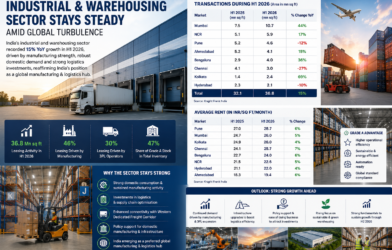
According to a latest Knight Frank Report, Industrial & Warehousing recorded 29% year-on-year (YoY) increase in warehousing demand to 72.5% sq ft across the eight primary markets of India, with Q4 2025 emerging as the strongest quarter of the year with 23.4 million sq ft transacted.
Amid a stable macroeconomic backdrop for industrial expansion, industrial and warehousing markets delivered a strong performance in 2025, driven by sustained demand from manufacturing third party logistics (3PL), e-commerce and allied sectors. The market’s performance reinforced India’s growing role as a resilient, scalable and strategically positioned hub within global and regional supply chain networks. Grade A facilities remained the preferred choice among occupiers, accounting for 63% of leased space in 2025, compared to 62% in the same period a year earlier.
Manufacturing occupiers (excluding FMCG and FMCD) maintained their lead as the largest demand driver, commanding 47% of total volume with 34 mn sq ft transacted in 2025 translating to a 55% YoY growth in the area leased by it during the period.Space take-up by e-commerce players increased 56% YoY in 2025, absorbing 7.8 mn sq ft, the highest annual volume recorded since 2021. The sector accounted for 11% to total market activity in 2025, indicating a steady recovery in demand and a stronger role in overall absorption.
Industry-Split of Transaction Volume in mn sq ft
| 2024 | 2025 | |||
| Mn sq ft | YoY % change | Mn sq ft | YoY % change | |
| Other Manufacturing | 22.0 | 18% | 34.2 | 55% |
| 3PL | 16.7 | -9% | 19.6 | 17% |
| E-commerce | 5.1 | 89% | 7.8 | 52% |
| Retail | 6.1 | 48% | 3.3 | -46% |
| FMCG | 2.3 | 92% | 3.0 | 29% |
| FMCD | 2.5 | -12% | 2.4 | -2% |
| Miscellaneous | 1.7 | -34% | 2.4 | 37% |
| Total | 56.4 | 12% | 72.5 | 29% |
Source: Knight Frank Research
While total transaction volumes across the eight primary markets reached 72.5 mn sq ft, 2025 reflected a clear shift in regional leadership. Pune emerged as the most prolific market, recording (16 mn sq ft) in transactions, marking an 86% YoY growth and capturing a 22% share of total volumes. Manufacturing transactions were notably concentrated in Pune and Chennai, which together accounted for 51% of manufacturing leasing activity during the year.
Market-Split of Transaction Volumes
| City | 2024 in mn sq ft | 2025 in mn sq ft | YoY % change |
| Pune | 8.6 | 16 | 86% |
| Mumbai | 10.3 | 13.5 | 31% |
| NCR | 9.2 | 12.2 | 33% |
| Chennai | 5.8 | 8.3 | 43% |
| Bengaluru | 6.6 | 8.2 | 24% |
| Ahmedabad | 5.8 | 6.4 | 10% |
| Kolkata | 6.5 | 4.6 | -29% |
| Hyderabad | 3.5 | 3.4 | -3% |
| Total | 56.3 | 72.6 | 29% |
Source: Knight Frank Research
Mumbai and NCR remained critical heavyweights, sustaining the sector’s momentum throughout the year. All markets except Kolkata and Hyderabad witnessed a growth in overall transaction volumes in 2025. The distribution of activity signals a maturing market where capital and occupiers increasingly align with established manufacturing ecosystems like in Pune.Secondary markets also sustained healthy momentum in 2025, recording 11.2 mn sq ft of leasing, marginally lower by 1% YoY compared to the record levels seen in 2024. Lucknow led activity with 1.9 mn sq ft of absorption, while Nagpur posted the strongest growth, surging 204% YoY to 0.9 mn sq ft. Grade A assets strengthened their dominance, accounting for 54% of total transaction volumes during the year.
The eight primary industrial and warehousing markets in India together held 549 mn sq ft of stock in 2025. Mumbai led the market with a 31% share of total stock, followed by NCR at 21%.
Robust transaction volumes kept vacancy stable at 11.6% during the year. While this reflects the availability of ready inventory across markets, the eight primary markets also offer significant headroom for future development. The eight cities collectively hold 256.2 mn sq ft of potential space within established warehousing parks, more than three times the annual transaction volumes recorded in 2025, providing adequate capacity to support near-term demand expansion.
Market-Split of Stock and Vacancy in 2025
| Market | Existing Stock mn sq ft | Vacancy |
| Mumbai | 169.7 | 14.3% |
| NCR | 115.4 | 15.8% |
| Bengaluru | 59.9 | 19.1% |
| Chennai | 46.5 | 9.6% |
| Ahmedabad | 44.8 | 11.4% |
| Pune | 44.1 | 9.7% |
| Kolkata | 41.8 | 8.4% |
| Hyderabad | 26.8 | 18.0% |
| Total | 549 | 11.6% |
Source: Knight Frank Research
According to Shishir Baijal, International Partner, Chairman and Managing Director, Knight Frank India, the Indian warehousing sector’s record performance in 2025 underscores the structural transformation underway in our supply chains . The market is witnessing the rise of a broader and increasingly diversified occupier base. As global trade realigns and infrastructure investments accelerate, we remain confident that India will further strengthen its position as a preferred manufacturing and distribution hub, driving sustained demand for high-quality, institutional-grade warehousing in the years ahead.
Share of Grade A stock
| Market | 2025 |
| Chennai | 78% |
| Pune | 69% |
| Kolkata | 57% |
| Hyderabad | 51% |
| Bengaluru | 50% |
| Ahmedabad | 48% |
| NCR | 39% |
| Mumbai | 29% |
| Total | 45% |
Source: Knight Frank Research
Beyond sustainability considerations, developers are placing greater emphasis on improved design standards and enhanced working environments within warehousing parks to meet evolving occupier expectations.
Rent growth in the warehousing market remained subdued for much of the past decade, gaining traction only from 2021 amid higher steel and cement costs and a recovery in occupier demand. At current levels, rents have limited downside as Grade A assets are being developed to higher industrial specifications while continuing to cater to warehousing users.While occupier activity has been robust and rent levels have risen compared to 2024 across all markets, growth has remained calibrated. The shift toward longer lease tenures, typically priced more competitively to reduce vacancy and cash flow risk, has tempered near-term rent escalation.
Weighted Average Transacted Rent (in INR/sq ft/month)
| Market | 2024 | 2025 | % Change |
| Pune | 26.6 | 28.0 | 5% |
| Chennai | 23.9 | 25.0 | 5% |
| Hyderabad | 20.7 | 21.5 | 4% |
| Bangalore | 22.5 | 23.2 | 3% |
| Mumbai | 24.5 | 25.2 | 3% |
| NCR | 21.3 | 21.9 | 3% |
| Ahmedabad | 18.2 | 18.6 | 2% |
| Kolkata | 24.8 | 25.0 | 1% |
Source: Knight Frank Research
The manufacturing outlook remains strong as firms continue diversifying supply chains and shifting production to India, supported by consistent government incentives. Growing 3PL participation in logistics optimization and the renewed strength of e-commerce are also set to play a pivotal role in driving the next phase of market expansion.