Subtotal ₹0.00






Email :83
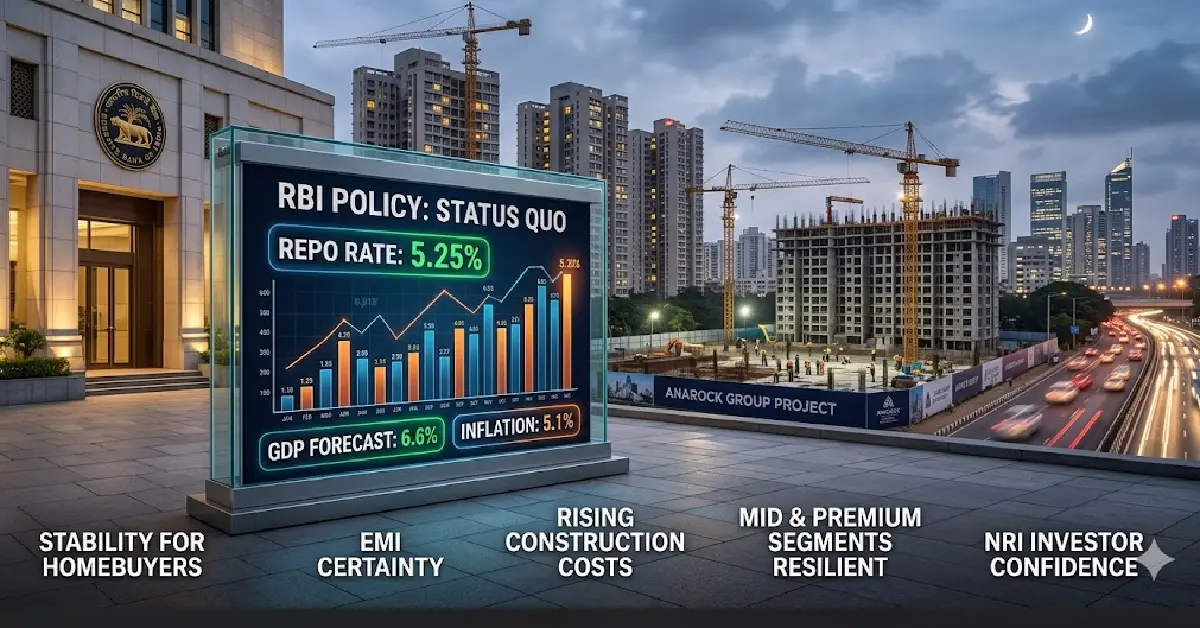
In a calibrated move to anchor domestic economic growth against a volatile global backdrop, the Reserve Bank of India (RBI) in its June policy review maintained the status quo on its policy repo rate, keeping it steady at 5.25% for the third consecutive time. While the central bank navigates mounting external pressures—including an escalating energy crisis pushing crude oil toward $110 per barrel, geopolitical conflicts in the Middle East, and the looming threat of an El Niño-induced weak monsoon—it has prioritized market predictability. For the Indian real estate sector, this policy consistency acts as a vital buffer.
Though industry leaders warn of supply-side inflation, rising construction costs, and a sequential dip in Q1 2026 sales, the overarching sentiment among developers and experts is highly optimistic. Steady EMIs and stable borrowing costs are expected to safeguard homebuyer confidence, sustain momentum in the premium and mid-housing segments, and keep India’s real estate growth story firmly on track through 2026.
Lata Pillai, Senior Managing Director and Head – Capital Markets, India, JLL: “The RBI maintained the status quo on the policy rate, keeping it at 5.25%, the third successive instance of the same action, with the stance remaining neutral as well, while noting a more cautious approach being employed by other global central banks. With the escalating energy prices and El Niño effect likely to weaken the monsoon season raising their twin heads, the inflation outlook has been revised upwards. While the GDP outlook has been slightly moderated, it remains strong at 6.6% for FY27, post the strong 7.6% growth in the previous year per the 2nd advance estimates. Though the stance has changed, the pause is likely to further weaken the rupee amid hardening global yields, and we may see RBI interventions continue during the year to arrest the currency slide.
The impact of the energy crisis and supply chain dislocations is expected to weigh heavily, with inflationary pressures likely to rise, though inflation still remains under 4%, comfortably within the target band. While a flexible inflation target provides headroom to monitor the impact of supply chain shocks as well as recent fuel price hikes, the RBI is expected to remain nimble-footed to tackle rising inflationary concerns later in the year through potential rate hike actions. Predictions of a weak monsoon due to El Niño are also expected to have a bearing on inflation forecasts, with an upward revision potentially beckoning later in the year.
Growth forecasts have been moderated amid the lingering energy crisis and the spillover effects of the geopolitical conflict, with future concerns highlighted to reflect evolving ground realities that may alter the next course of action.
For the time being, the status quo on interest rates is positive for the real estate market, with certainty on lending rates for both developers and homebuyers expected to keep stakeholders relatively unfazed. However, the impact of rising construction costs looms large on the horizon, as developers may end up passing such higher input costs on to buyers, which may adversely impact affordability. Amid the shrinking share of affordable housing, this may further impact the mid-segment buyer even as the higher-priced segments remain buoyant. However, diminishing stock market returns and overall uncertainty may start to take a toll on overall housing market sentiment to some extent going forward.”
Anuj Puri, Chairman, ANAROCK Group: “The RBI’s Monetary Policy Committee (MPC) decision to keep the repo rate unchanged is a key anchor for the Indian residential real estate market. The sector is witnessing strong annual growth amid short-term geopolitical shocks, and this rate pause reflects rising consumer pressures and volatile construction environments.
External vulnerabilities have tested the broader macroeconomic environment in early 2026. The ongoing war in the Middle East is having direct economic effects, including higher global oil prices and higher domestic construction costs. This sort of supply-side inflation is putting pressure on developers.
Also, rising geopolitical uncertainty has led many potential Middle Eastern investors, who tend to put large amounts of money into Indian housing, to pause their buying. Constant borrowing costs mean that the market is not being punished by rising material costs and rising loan rates.
According to ANAROCK Research, residential sales declined 7% quarter-on-quarter (Q-o-Q) with approx. 1,01,675 units sold in Q1 2026 vis-à-vis 1,08,970 units in Q4 2025. Total value of sales fell 5% q-o-q to INR 1.51 Lakh Crore. On the other hand, demand is still strong Y-o-Y. Sales volume and sales value in Q1 2026 grew by 9% and 6% respectively over Q1 2025 that saw sales of 93,280 units worth INR 1.42 Lakh Crore.
New project launches are now outpacing sales velocity, reversing post-pandemic trends. Total new supply increased sequentially by 2% and was up 26% YoY, meaning more than 1,26,265 units were newly launched in Q1 2026. Therefore, the unsold inventory available rose by 4% QoQ and 7% YoY to go beyond 6.01 lakh units by the end of Q1 2026. To absorb this growing inventory, a stable and affordable financing environment is needed.
The MPC’s policy consistency is a stabilising buffer. Input costs are rising and need to be managed carefully, but domestic consumer demand is fundamentally resilient. The Central Bank’s efforts to stabilize the Indian rupee will help boost import of fixtures and fittings in the luxury segment, which currently accounts for 20% of the housing supply as of Q1 2026.
Overall, this rate pause has shielded home loan structures, enabling the sector to absorb inventory gains and keep growth story going through 2026.”
Shekhar G Patel, President, CREDAI: “RBI’s decision to keep the repo rate unchanged at 5.25%, while maintaining a neutral policy stance and retaining the CRR at 3%, indicates a calibrated response amidst the current global economic environment. With geopolitical tensions, inflationary concerns, and currency volatility continuing to influence markets globally, policy continuity will bode well for the real estate sector and help sustain overall market stability. The revised GDP growth projection of 6.6% reflects confidence in the resilience of domestic economic activity despite external uncertainties. With borrowing costs remaining steady, housing demand, particularly across mid-income and premium segments, is expected to remain resilient. At the same time, the policy reflects a balanced approach towards supporting growth while remaining watchful of inflationary risks. However, continued policy support will remain important to address the demand-supply gap in affordable housing. The growth prospects of the sector have remained stable and disciplined, supported by infrastructure expansion and increasing preference for organised developments across major cities. Given the neutral stance, the announcement is expected to further strengthen investor, end-user, and homebuyer confidence.”
Tanuj Shori, Founder & CEO, Square Yards: “For aspiring homebuyers, the RBI’s decision to maintain the repo rate at 5.25% provides a stable environment for financial planning and reinforces confidence in long-term property purchases. With borrowing costs remaining steady, homebuyers can evaluate opportunities with greater certainty, which is particularly important for end-users and first-time buyers.
Beyond the rate decision, the measures announced to encourage greater participation by NRIs, OCIs, and foreign investors in Indian financial markets are a significant positive for the broader economy. By facilitating higher overseas investments and enhancing the attractiveness of Indian debt and equity markets, these initiatives are expected to support capital inflows, strengthen investor confidence, and reinforce India’s position as a preferred global investment destination.
For the real estate sector, stronger economic sentiment and deeper engagement from the global Indian diaspora could translate into increased interest in residential assets. NRIs already account for a meaningful share of premium housing demand, and these measures are likely to further strengthen their confidence in India’s long-term growth story. Combined with a stable interest rate environment, this should provide continued support to housing demand across key residential markets.”
Shrinivas Rao, FRICS, CEO, Vestian: “The Reserve Bank of India kept the repo rate steady amid evolving global uncertainties to gauge its overall impact on the Indian economy before initiating any rate-hike cycle. This decision has provided some financial relief to the real estate sector, which continues to grapple with rising construction costs driven by elevated inflation. Developers and investors also continue to benefit from unchanged borrowing costs, helping sustain healthy demand-supply dynamics in the market. However, the central bank is likely to hike repo rate in the coming months to contain inflationary pressures stemming from rising fuel prices and the prospect of a weaker monsoon.”
Avneesh Sood, Director, Eros Group: “The RBI’s decision to hold the repo rate at 5.25% provides much-needed certainty for homebuyers at a time when global events are creating volatility across markets. Despite the sharp rise in crude oil prices to nearly USD 110 per barrel and the RBI raising its FY27 inflation forecast to 5.1%, the central bank has chosen stability over abrupt policy action. For prospective homebuyers, this means that the benefits of the 125 basis points of rate cuts delivered over the past year remain intact. While rising inflation and construction costs may keep property prices on an upward trajectory, stable borrowing rates, healthy liquidity, and resilient economic growth should continue to support housing demand. In the current environment, predictability in interest rates is perhaps more valuable than an additional rate cut.”
Parvinder Singh, CEO, Trident Realty: “The RBI’s decision to keep the repo rate unchanged is a welcome signal of stability in the current economic environment. Stability in interest rates will provide confidence to prospective buyers, and it allows them to make long-term financial commitments with greater certainty. For developers, a predictable rate environment supports better planning and execution while helping to maintain the momentum across the sector. An unchanged rate environment will support investment decisions and provide greater visibility for long-term planning.”
Aman Shharma, Managing Director and Founder, Aarize Group: “RBI’s decision to hold repo rate steady is a welcome signal of stability in the current economic environment. It brings continuity for homebuyers as EMIs remain unchanged, helping them plan their finances with greater confidence. While global headwinds and input costs continue to pose challenges, a stable rate environment allows developers to focus on execution and timely delivery instead of reacting to volatility. For the sector, this stability helps to sustain buyer sentiment and keeps investment momentum intact, particularly in markets driven by end users. It’s a measured move that supports sustained long-term housing demand.”
Anil Godara, Founder and Managing Director, J Estates: “The RBI decision to maintain the repo rate at 5.25 % brings stability and predictability to the market. The sector is now being driven by stronger fundamentals, greater transparency, and a more discerning buyer base. With continued urbanization, infrastructure expansion and rising buyer confidence, the sector is well positioned to sustain its growth momentum. A steady interest rate environment supports buyer confidence and reinforces the sector’s long-term growth outlook.”