Subtotal ₹0.00







Email :58
Early investment in developing areas can deliver higher returns as land and property prices are low, rapid urban growth drives future demand and infrastructure and connectivity projects like highways and metro rail significantly boost property value over time.
Those who anticipate a city’s growth before it materialises, get long-term value in real estate. The significant scale of change amid infra push opens vast new opportunities for growth, far more than existing cities can hold. These opportunities will flow instead to the areas that are still taking shape. In such developing regions, improved connectivity, new infrastructure, and rising economic activity are only beginning to translate into value. For investors willing to enter at this stage, the opportunity is not simply about favourable timing. It is about positioning for appreciation and value creation well before the wider market catches on.
With early investment, one gets an opportunity to enter market before it reaches its full potential. This allows an investor to benefit fully from the growth drivers still ahead of it, rather than paying a price that already reflects them. Research across real estate markets consistently shows that properties in newly developing areas see their sharpest appreciation once essential infrastructure and commercial facilities become operational. Investors entering early are not just buying at a lower cost; they are buying with far greater choice and are able to select the strongest positions within a promising area before competition for those positions intensifies.
For an investor, the lower entry cost is where the advantage begins. Properties in developing locations are priced well below their mature-market equivalents, simply because the value they will eventually hold has not yet been built in. That gap between current price and future worth is precisely what an early investor is buying. It means capital can secure a stronger position than it ever could in an already-established district.
The infrastructural development in the form of new roads, expressways, metro routes, railway infrastructure improvements, and airports have consistently proven to be the single strongest catalyst for real estate development. Wherever such infrastructure comes up, property demand and value follow with remarkable consistency. Data on transit-oriented development shows that properties within walking distance of a metro or transit station typically command a premium of roughly 10% to 30% over comparable properties without that access. This premium frequently builds well before a station has even opened.
The metropolitan growth reinforces this pattern. Urban cores/ city centres are geographically finite, and as cities expand, their boundaries are pushed steadily outward. This is not a temporarytrend but a structural feature of urbanisation, and it reliably increases demand on the periphery long before that demand is fully priced in.
Further, that demand is sharpened by the development of business centers and job opportunities. The creation of business parks, industrial zones, and commercial hubs does more than generate employment. It draws a resident population that needs housing within a reasonable commute, and that need translates directly into sustained demand for real estate in the surrounding area. This is where increased demand and reduced supply take hold. Once a location and its trajectory become widely recognised, demand accelerates far faster than new supply can follow, and that mismatch drives the sharpest phase of appreciation.
This results in an improved appreciation value. Mature markets can offer stability, but their scope for further growth is naturally limited by how much of their potential has already been realised. Emerging markets remain firmly within their growth cycle, and that is precisely where the strongest appreciation potential lies.
Profitable real estate investments rarely come from timing the market. Rather, they come from reading it correctly ahead of time – from a clear view of infrastructure plans, economic direction, and the pace at which a location is developing. As roads are built, industries settle in,
and population grows, a developing area steadily becomes a thriving urban centre, and property values rise in step with that transformation from the very beginning.
and population grows, a developing area steadily becomes a thriving urban centre, and property values rise in step with that transformation from the very beginning.
Developing locations offer a rare combination for those willing to look closely enough to seeit: entry prices that have not yet caught up with a location’s potential, and clear visibility into the forces that will drive its growth. The investors who commit at this stage are not simply acquiring property,rather they are taking a position in a place’s future, long before that future becomes evident to the wider market.
-Himanshu Luthra, MD, Divine Vision Infratech
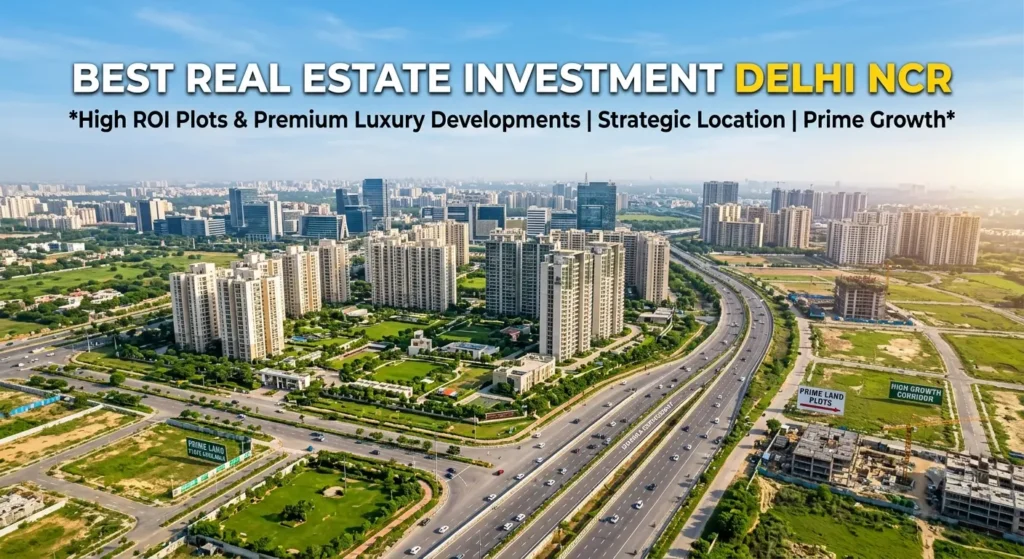
Housing Hotspots with High Price Gains
Over the past six years, prime pan-India residential real estate markets have seen significant surge in capital and rental values with top NCR cities of Gurugram and Noida, besides Mumbai, Delhi and southern markets of Bengaluru and Hyderabad have clocked high capital and rental gains.
According to a recent research report of Anarock, Indian residential real estate market showed alluring proposition of significant capital appreciation and improving rental income potential across the country’s leading cities. The research analysis of rental yield and capital values data from the top 11 housing markets in the country between 2019 and Q2 2026 shows that both capital values and rental yields grew almost in tandem in those cities.
Among the top 11 analysed cities, Noida and Gurugram lead capital appreciation by 125% and 117% while rental yields there also rose by 70 bps and 80 bps, respectively. In Noida, average capital prices increased from INR 4,795 per sq. ft. in 2019 to INR 10,780 per sq. ft. in Q2 2026; rental yields improved from 3.2% to 3.9%. Gurugram saw capital prices rise from INR 6,150 per sq. ft. to INR 13,350 per sq. ft. while rental yields increased from 3.5% to 4.3%.
In Bengaluru and Hyderabad strong economic and employment ecosystems are driving both capital appreciation and rental values growth. These two Southern cities recorded the sharpest rental yield gains between 2019 to Q2 2026, even as capital value appreciation kept pace in both the cities: In Bengaluru, capital prices jumped from INR 4,975 per sq. ft. in 2019 to INR 9,450 per sq. ft. in Q2 2026 – 90% growth. In the same period, rental yields rose from 3.6% to 4.6% – a 100-basis-point gain. Hyderabad also recorded strong capital appreciation, with prices increasing from INR 4,195 per sq. ft. to INR 8,090 per sq. ft. – a 93% gain in this period. Rental yields also rose 100-bps – from 2.6% to 3.6%.
| Cities | Capital Price (INR/Sqft) 2019 | Capital Price (INR/Sqft) Q2 2026 | % Change |
| Gurgaon | 6,150 | 13,350 | 117% |
| Noida | 4,795 | 10,780 | 125% |
| Delhi | 18,200 | 26,700 | 47% |
| Pune | 5,510 | 8,300 | 51% |
| Bangalore | 4,975 | 9,450 | 90% |
| Mumbai | 17,845 | 29,270 | 64% |
| Navi Mumbai | 6,860 | 11,720 | 71% |
| Thane | 8,785 | 14,300 | 63% |
| Kolkata | 4,385 | 6,345 | 45% |
| Hyderabad | 4,195 | 8,090 | 93% |
| Chennai | 4,935 | 7,250 | 47% |
The surge in capital and rental values is driven by a combination of factors, including infrastructure development, expansion of employment hubs, growth of GCCs, and sustained migration into the country’s metros. Distinct residential investment markets now offer different combinations of capital appreciation and rental income growth. Noida and Gurugram deliver exceptional capital appreciation alongside improving rental yields, while Bengaluru and Hyderabad combine near doubling of capital values with the sharpest improvement in rental yields. Both cases highlight the role of employment growth, technology, and GCC expansion in driving both ownership and rental demand. Mumbai and Delhi represent more mature markets where rental yields have strengthened more than capital values between 2019 and Q2 2026 – indicating a gradual improvement in rental economics.
Sums up Anuj Puri, Chairman, Anarock, ” Rising property prices are generally inversely proportional to rental yields, exerting downward pressure on the latter. While rents do not keep pace with capital appreciation, the country’s top residential markets are diverging sharply from this trend.