Subtotal ₹0.00






Email :13
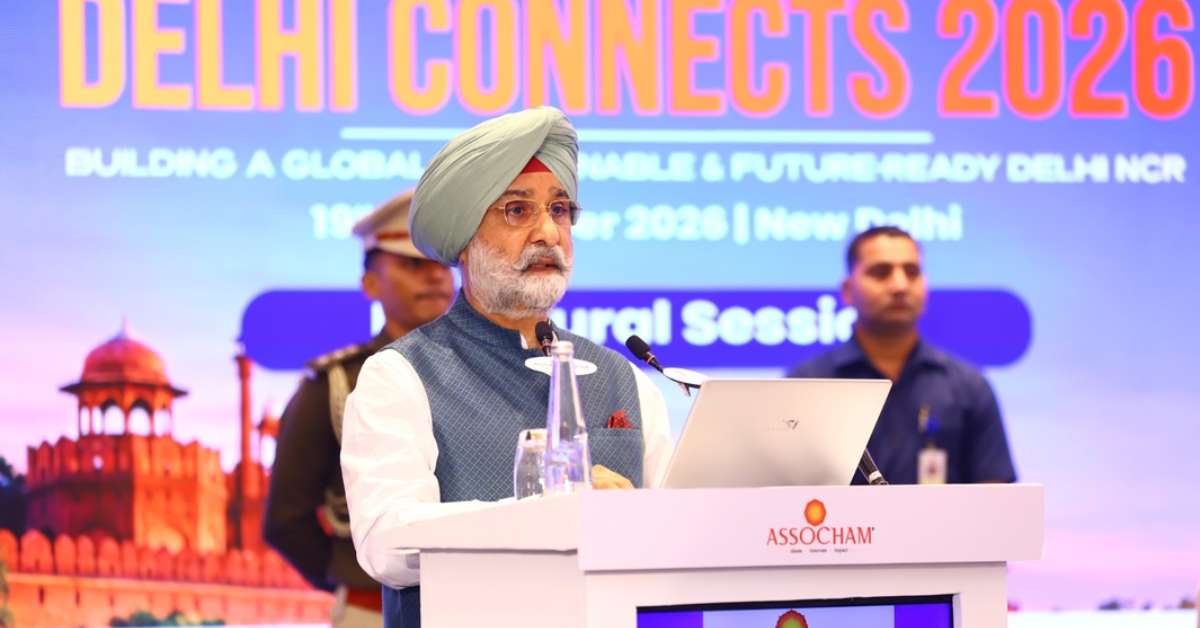
The Associated Chambers of Commerce and Industry of India (ASSOCHAM) organised Delhi Connects 2026 recently in New Delhi, bringing together policymakers and industry leaders to deliberate on building a globally competitive, sustainable and future-ready Delhi NCR.
Sardar Taranjit Singh Sandhu, Lieutenant Governor of Delhi, said that, “Delhi by 2047 must be a city that attracts investment, creates opportunities, strengthens its infrastructure and preserves its rich heritage. As Lieutenant Governor, I see value in facilitating dialogue and coordination among stakeholders so that ideas can be translated into meaningful outcomes. Integrated transport, planned urban development, technology-led governance and economic competitiveness are four priorities for Delhi.”
He added that, “Delhi’s development cannot be seen in isolation from the wider NCR, calling for coordinated regional planning on transport, housing, water management and economic development. Delhi’s GSDP is estimated at ₹13.27 lakh crore with projected growth of 9.42 per cent, while services contribute over 86 per cent of its economy. He also highlighted that industry associations can help connect government institutions with businesses, universities, start-ups and global expertise.”
Sardar Manjinder Singh Sirsa, Minister of Industries, Food & Supplies, Forest & Environment, and Forest & Wildlife, Government of NCT of Delhi, said, “Delhi’s growth must not come at the cost of the environment. He highlighted the government’s vision for 2047, which pairs economic growth with clean air and clean water, and stressed that achieving it requires collective responsibility from government, industry and citizens.”
He also acknowledged the business community’s cooperation during temporary construction restrictions as part of the collective effort towards addressing environmental challenges. Referring to the city’s population of about 35 million, he highlighted the scale of its waste management challenge, noting that nearly 14,000 metric tonnes of municipal waste are handled daily, alongside a substantial legacy waste burden. He added that nearly 60% of legacy waste dumps have been removed, reclaiming about 100 of 220 acres, and pointed to the redevelopment potential of industrial estates, including enhanced Floor Area Ratio (FAR), to enable planned urban and industrial development.
Pradeep Aggarwal, Chairman, National Council on Real Estate, Housing & Urban Development, ASSOCHAM, and Founder & Chairman, Signature Global (India) Ltd. said that, “Delhi NCR is an important engine of India’s growth and that sustainability must be embedded in the foundation of its development. He noted that India’s built-up area is expected to grow nearly 2.5 times by 2040, giving the real estate sector a significant responsibility in advancing the Net Zero 2070 ambition.”
He further added that, “sustainability is increasingly becoming an industry standard rather than remaining a voluntary commitment. He also called for a stronger circular economy through recycled construction materials of assured quality, reliability and availability, and said the sector will be critical to realising Viksit Bharat 2047 by enabling housing, employment and sustainable urban development. Highlighting India’s growing green building ecosystem, he noted that the country has more than 20,000 registered green building projects and is the world’s second-largest green building market. He stressed the need for practical solutions and stronger government-industry partnerships to accelerate sustainable construction and urban development.”
Delivering the vote of thanks, Updeep Singh Chatrath, Chairman, ASSOCHAM National Council on Textiles and Technical Textiles, and Resident Director, Welspun World said that, “The future of Delhi-NCR would be shaped by strong government-industry partnerships. He emphasised that combining the government’s policy leadership with industry’s investment and innovation would help build a globally competitive, sustainable and inclusive region, reaffirming ASSOCHAM’s commitment to bringing stakeholders together to translate this vision into action.”
The inaugural session also witnessed the release of the ASSOCHAM Knowledge Report, presenting insights and perspectives on the development priorities of the Delhi-NCR region.
The Summit underscored the importance of government-industry collaboration, coordinated planning and sustainable development in shaping a globally competitive and future-ready Delhi-NCR.