Subtotal ₹0.00






Email :130
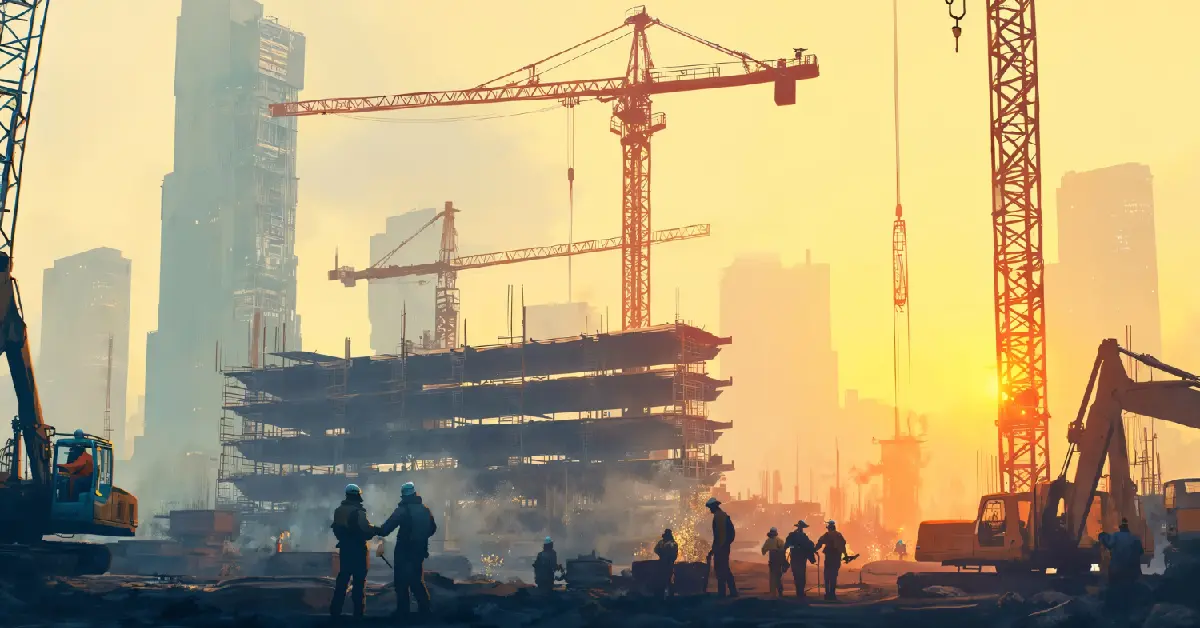
In the evolving market dynamics amid ongoing Israel -America war with Iran, causing steep rise in oil prices and unprecedented spurt in global supply chain, the increase in building material prices, together with rise in labour cost due to new Labour Code and skilled labour shortage, will see construction costs escalating across all asset classes .
According to JLL’s India Construction Cost Guide 2026, construction costs are projected to rise 3-5% across all asset classes in 2026. Any further cost escalation due to war which has not been assessed , will be in addition to this.
In 2025, material costs presented a mixed picture with divergent trends across categories. Cement, Steel and Diesel prices showed a mild decrease of 1-2%, 3-4% and 5-6%, while Aluminium and Copper costs experienced more significant increases of 8-9% and 9-10% respectively, driven by global demand pressures and supply chain dynamics. Labour costs are experiencing the most consistent upward pressure, increasing by 5-6% across all categories, driven by skilled labour shortages and infrastructure demand.
While the government’s GST 2.0 initiative delivers a critical 10% tax relief on cement, promising savings of 2-3% for developers and property prices by 1-1.5% for homebuyers, the new labour code which took effect in November 2025, mandate enhanced social security benefits, healthcare coverage, and standardized wage frameworks, driving labour costs up 5-12% across all skill categories. The net result: construction costs may rise 3-5% this year which may have an impact on project economics.This trend also reflects the construction industry’s strategic shift toward long-term value creation while navigating significant regulatory changes and evolving market dynamics.
According to Aditya Desai, sExecutive Director, PDS India, JLL , success in 2026 belongs to those who evolve beyond cost management to strategic transformation. “What we are witnessing across India’s six major cities tells the story: Mumbai commands INR 4,600-5,200 per sq. ft. for luxury high-rises, while Chennai, Bangalore, and Hyderabad deliver competitive rates at INR 4,200-4,800 per sq. ft. This isn’t just a cost differential—it is fundamentally reshaping capital allocation, driving the Tier-II expansion, and redefining India’s real estate geography. Those who remain vigilant and adapt proactively will capture outsized opportunities in this transformed landscape,” he says.
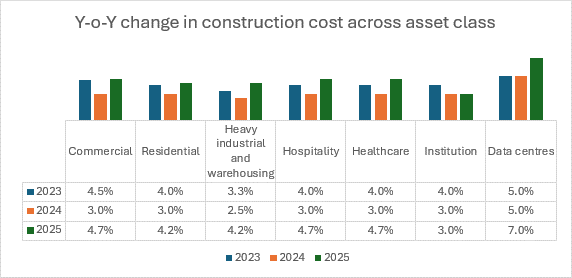
Note: *The above % change has been averaged out for all major cities which include Delhi NCR, Mumbai, Bengaluru, Hyderabad, Chennai and Pune
The changing world dynamics is causing disruption to energy markets and prices. However, currently it is impossible to gauge whether there will be any lasting impact or not.“Construction costs in 2026 are expected to rise 3-5%, driven by regulatory changes, skilled labor scarcity, and stricter environmental standards. Digital technologies help offset these pressures by improving efficiency and delivering greater project value. Despite rising global construction costs and market uncertainty, significant opportunities are emerging. The sector’s shift toward sustainability, digital transformation, and adaptive practices creates a strong rationale for strategic investment. Companies prioritizing agility and operational efficiency today will build enduring competitive advantages that extend well beyond 2026 in an increasingly dynamic market environment,” says Ashok VS, Head of Cost Management, JLL PDS, India. India’s construction sector in 2026 is defined by resilience amid transformation. While geopolitical factors continue to evolve, the sector is positioned to deliver strong growth supported by favorable regulatory reforms and robust expansion across all market segments. The 3-5% cost increase represents remarkable stability given the magnitude of regulatory changes underway. Developers who embrace workforce formalization, leverage GST savings strategically, and invest in technology adoption will emerge as leaders in this dynamic landscape