Subtotal ₹0.00






Email :103
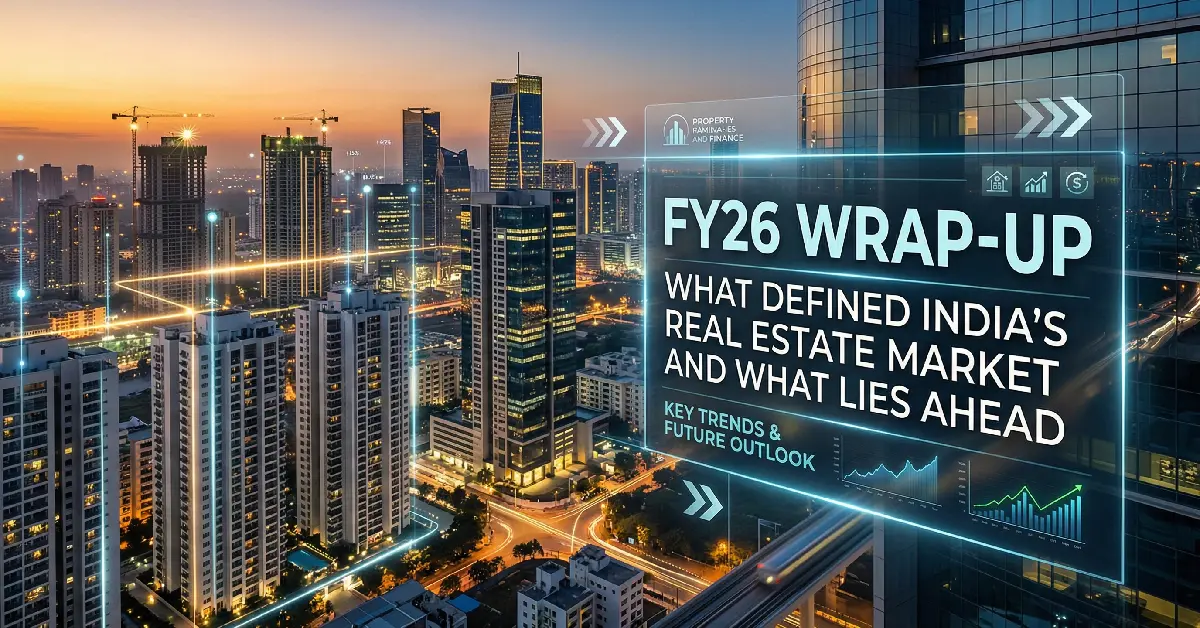
FY26 proved to be a transformative year for India’s real estate sector, marking a shift from the usual cyclical recoveries to a more structural, demand-driven growth phase. Residential markets continued to absorb inventory steadily across major metros while emerging Tier-2 cities, buoyed by improved infrastructure and lifestyle amenities, began to assert themselves as serious growth engines.
Residential real estate in FY26 maintained a steady momentum, with demand remaining robust across metros such as Mumbai, Delhi-NCR, Bengaluru, and Hyderabad. As per Knight Frank India, homes priced above Rs. 1 crore made up 50% of total residential sales across the top eight cities in 2025, up from 44% a year earlier. The shift comes at a time when overall market activity has started to stabilise following a post-pandemic surge. The trend underscores how demand is increasingly being driven by financially stronger buyers upgrading homes, even as mass-market demand shows signs of strain.
Tier-2 cities, including Pune, Chandigarh, Lucknow, Panipat, and Jaipur, emerged as key growth drivers, attracting buyers drawn by improved connectivity, social infrastructure, and comparatively affordable options. The premium and luxury segments, in particular, saw heightened interest, reflecting a shift in buyer aspirations toward larger, well-appointed homes with lifestyle-centric amenities. Analysts note that infrastructure-led developments, new expressways, metro corridors, and integrated townships, combined with a rise in genuine end-user demand over speculative buying, are reshaping residential markets across the country.
Gurpal Singh Chawla, Managing Director, TREVOC, says, “The trajectory of India’s real estate market is set to be shaped by structural trends rather than short-term cycles. Developers who combine strategic location selection, lifestyle-driven offerings, and quality design will continue to capture value. Emerging Tier-2 markets like Panipat and premium residential corridors in NCR will remain investment magnets. We foresee FY27 seeing a deeper alignment between end-user demand, investor appetite, and sustainable development. This would create opportunities for players who can think beyond transactions and build communities that are both livable and investment-grade.”
On the commercial front, office demand staged a robust comeback, led by multinational companies and GCCs expanding their footprints. The sector closed 2025 on a historic high, registering net absorption of 61.4 million square feet (MSF) across the top eight cities, as per the C&W report.
Retail, too, saw a revival, with experiential formats and curated destinations driving footfalls and signalling renewed investor confidence. Anarock report showed around 3.2 million sq ft absorbed in Q3 2025 alone, reflecting a 65% YoY growth and strong brand expansion appetite. High footfalls, residential expansion and infrastructure upgrades are driving strong retail absorption across key NCR corridors. While tier-II cities are emerging as new retail investment micro-markets.
Moreover, infrastructure continued to play a pivotal role in shaping real estate demand in FY26, acting as a key multiplier across both residential and commercial segments. Major projects such as the Dwarka Expressway, Golf Course Extension Road, and SPR significantly improved connectivity, while metro expansions in Delhi, Bengaluru, Hyderabad, and Pune made peripheral locations far more accessible.
New urban corridors and smart city initiatives further bolstered investor confidence, driving both price appreciation and increased interest in emerging micro-markets. As developers and buyers increasingly factor in ease of mobility and integrated infrastructure, these projects are not just shaping growth but redefining the geography of opportunity in India’s real estate landscape.
Paras Rai, Managing Director and Co-Founder, Property Master, says, “FY26 has been a landmark year for luxury housing in Gurugram, with premium developments increasingly defining the city’s residential landscape. Buyers are no longer seeking just homes; they are looking for thoughtfully designed communities that integrate wellness, lifestyle, and convenience. Low-density townships, clubhouse-led amenities, and proximity to key corporate hubs are driving demand in corridors such asFaridabad-Noida-Ghaziabad (FNG) Expressway, Urban Extension Road-II (UER II) and Dwarka Expressway. Developers who prioritize quality, design, and experiential living are setting new benchmarks, making luxury housing not just aspirational but a robust investment proposition as we move into FY27.
Besides, demand was driven by high-net-worth individuals seeking not just homes, but holistic lifestyle experiences that integrate wellness, recreation, and curated social spaces. Aspirational buyers are gravitating toward developments that offer both exclusivity and long-term value, signalling that experiential living is no longer a niche concept but a defining feature of India’s evolving luxury real estate landscape.
Mohit Kalia, Sr. Vice president-Sales & Marketing, HCBS Developments, says, “Luxury housing in FY26 became a story of lifestyle evolution. Corridors like Dwarka Expressway are seeing communities designed for holistic living, integrating green spaces, wellness amenities, and smart urban planning. Demand is no longer purely functional; buyers are looking for experiences, community, and long-term value. Developers responding to this trend are investing in quality materials, sustainable designs, and iconic architectural narratives. As these micro-markets mature, they are setting benchmarks for luxury in India, demonstrating that the sector’s growth is both aspirational and structurally robust.”
Looking ahead to FY27 and beyond, India’s real estate market is entering a phase of strategic growth and diversification. Tier-2 cities are expected to continue their upward trajectory, driven by improved connectivity and lifestyle infrastructure, while luxury housing is set to evolve further into experience-led townships that blend wellness, leisure, and community living. Commercial offices will increasingly adopt hybrid work models, demanding flexible, amenity-rich spaces, and retail will pivot toward omni-channel experiences with curated, destination-oriented formats. For investors and developers, opportunities are ripe in upcoming metro corridors, smart city developments, and niche segments such as co-living, senior living, and integrated mixed-use precincts, signalling a forward-looking market that balances aspiration with long-term value creation.