Subtotal ₹0.00






-Sanjeev Kathuria, Founder & CEO, Torbit Consulting
Short Quick Read
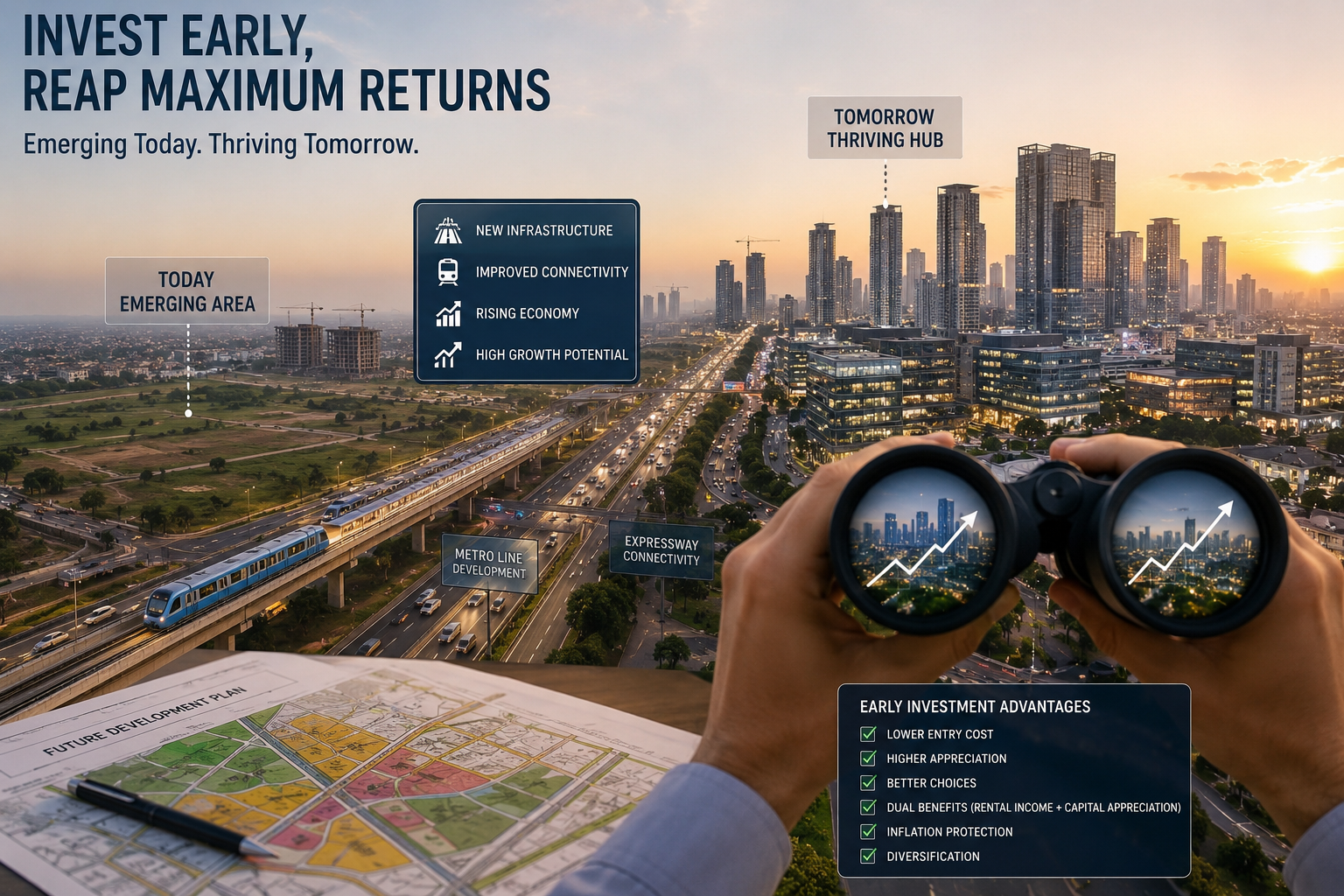
Long-term value in real estate has always accrued to those who anticipate a city’s growth before it materialises and the scale of growth underway will make this decisive. That scale of change opens vast new ground for growth, far more than existing cities can hold. It will flow instead to the districts that are still taking shape — the developing regions where improved connectivity, new infrastructure, and rising economic activity are only beginning to translate into value. For investors willing to enter at this stage, the opportunity is not simply about favourable timing. It is about positioning for appreciation and value creation well before the wider market catches on.
Read More…
The essential premise of early investment is straightforward: entering a market before it reaches its full potential . It allows an investor to benefit fully from the growth drivers still ahead of it, rather than paying a price that already reflects them. Research across real estate markets consistently shows that properties in newly developing areas see their sharpest appreciation once essential infrastructure and commercial facilities become operational — the value that was implicit in a location’s potential becomes explicit the moment that potential is realised.
This timing advantage compounds with a practical one. Investors entering early are not just buying at a lower cost; they are buying with far greater choice and are able to select the strongest positions within a promising area before competition for those positions intensifies.
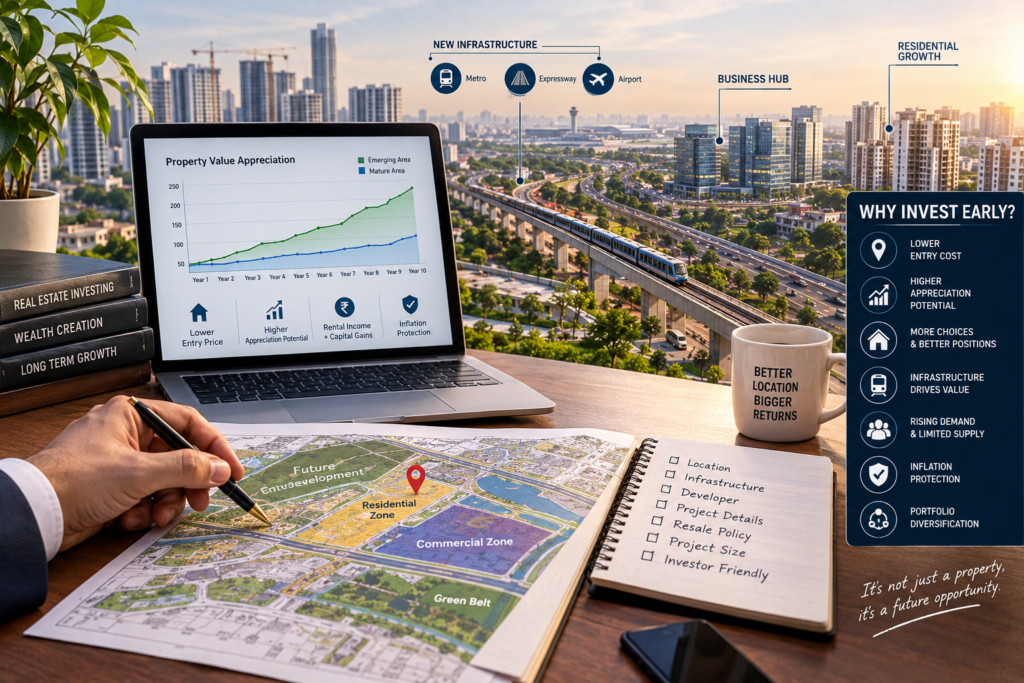
This lower entry cost is where the advantage begins as properties in developing locations are priced well below their mature-market equivalents, simply because the value they will eventually hold has not yet been built in. That gap between current price and future worth is precisely what an early investor is buying, and it means capital can secure a stronger position than it ever could in an already-established district.
The development of infrastructural facilities is what most reliably drives that shift. New roads, expressways, metro routes, railway infrastructure improvements, and airports have consistently proven to be the single strongest catalyst for real estate development. Wherever such infrastructure lands, property demand and value follow with remarkable consistency. Data on transit-oriented development shows that properties within walking distance of a metro or transit station typically command a premium of roughly 10% to 30% over comparable properties. This pattern is reinforced by metropolitan growth. Urban cores are geographically finite, and as cities expand, their boundaries are pushed steadily outward. This is not a temporary trend but a structural feature of urbanisation, and it reliably increases demand on th periphery long before that demand is fully priced in.
That demand is sharpened further by the development of business centers and job opportunities. The creation of business parks, industrial zones, and commercial hubs does more than generate employment. It draws a resident population that needs housing within a reasonable commute, and that need translates directly into sustained demand for real estate in the surrounding area.
This is where increased demand and reduced supply take hold. Once a location trajectory becomes widely recognised, demand accelerates much faster than new supply can follow, and that mismatch drives the sharpest phase of appreciation.
What results is an improved appreciation value. Mature markets can offer stability, but the scope for further growth is naturally limited by how much of their potential has already been realised. Emerging markets remain firmly within their growth cycle, and that I precisely where the strongest appreciation potential lies.
Real estate investments in areas with developing infrastructure and a strengthening economy have consistently shown strong, sustained rates of growth over time. It also offers a genuine dual source of returns, remaining one of the few mainstream assets that pays an investor twice- through rental income generated along the way and through capital appreciation realised at exit.
As replacement costs, land values, and rents rise alongside the broader price level, real estate has long provided reliable inflation protection, preserving purchasing power in a way many financial products cannot. Property values also move largely independently of equities and bonds, so adding real estate to portfolio delivers genuine diversification, spreading risk rather than simply adding another line item to it. The most profitable real estate investments rarely come from timing the market. They come from reading it correctly ahead of time-from a clear view of infrastructure plans, economic direction, and the pace at which a location is developing. As roads are built, industries settle in, and population grows, a developing area steadily becomes a thrivin urban centre, and property values rise in step with that transformation from the very beginning.
Developing locations offer a rare combination for those willing to look closely enough to seeit: entry prices that have not yet caught up with a location’s potential, and clear visibility into the forces that will drive its growth. The investors who commit at this stage are not simply acquiring property, they are taking a position in a place’s future, long before that future becomes evident to the wider market. – Himanshu Luthra, MD, Divine Vision Infratech