Subtotal ₹0.00






Short Quick Read
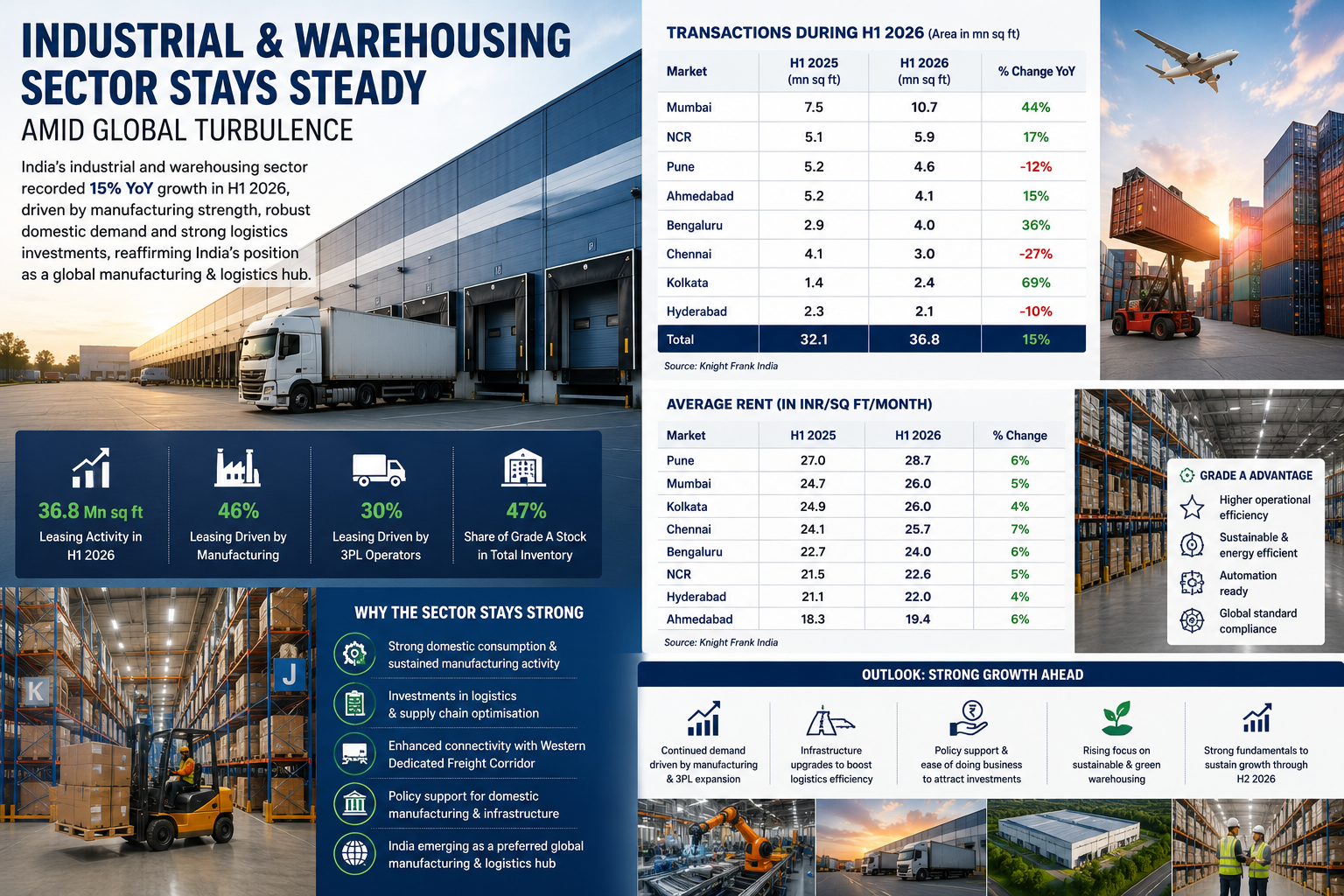
Despite facing West-Asia war related global headwinds of rising crude oil prices, elevated freight costs and weaker rupee, India’s industrial and warehousing sector has shown remarkable resilience, recording 15% YoY during the first half of 2026, with manufacturing contributing a dominant 46% of total leasing. On account of strong fundamentals, the sector will remain on a strong growth trajectory through the second half of 2026.
Read More…
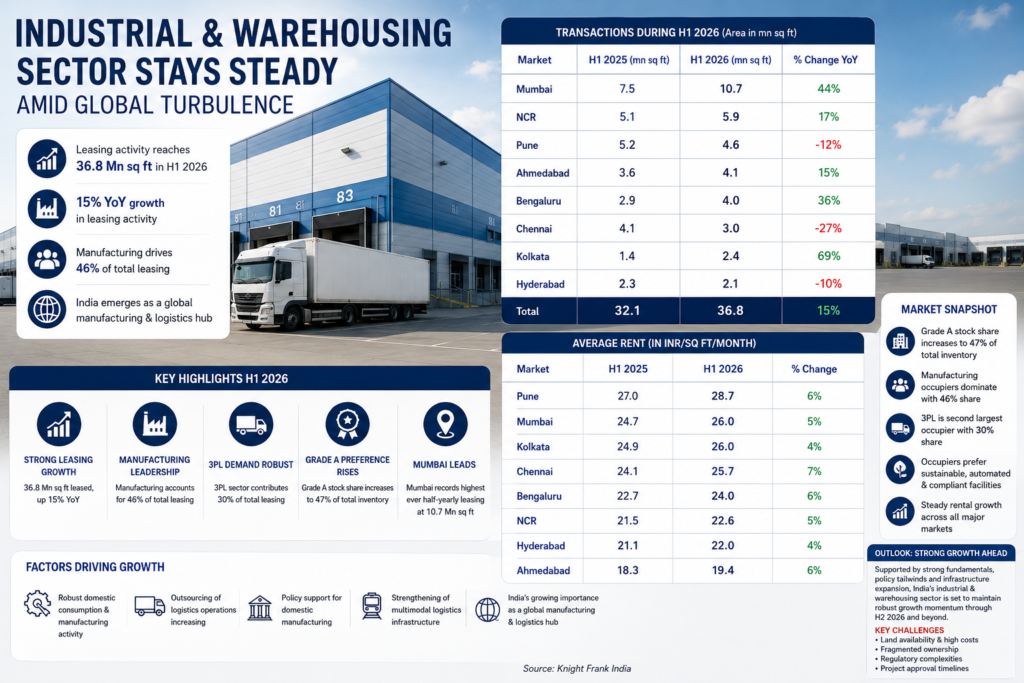
According to a recent Knight Frank report, leasing activity across the country’s eight primary industrial and warehousing markets reached 36.8 million sq ft during the first half of 2026, supported by robust domestic consumption, sustained manufacturing activity and continued investments in logistics sector, reaffirming India’s growing importance as a global manufacturing and logistics hub. The enhanced connectivity with the completion of Western Dedicated Freight Corridor strengthened occupier confidence, enabling manufacturers and logistics operators to further optimise supply chains.
TRANSACTIONS DURING H1 2026 (Area in mn sq ft)
| H1 2025 (mn sq ft) | H1 2026 (mn sq ft) | % Change YoY | |
| Mumbai | 7.5 | 10.7 | 44% |
| NCR | 5.1 | 5.9 | 17% |
| Pune | 5.2 | 4.6 | -12% |
| Ahmedabad | 3.6 | 4.1 | 15% |
| Bengaluru | 2.9 | 4.0 | 36% |
| Chennai | 4.1 | 3.0 | -27% |
| Kolkata | 1.4 | 2.4 | 69% |
| Hyderabad | 2.3 | 2.1 | -10% |
| Total | 32.1 | 36.8 | 15% |
Source: Knight Frank India
Mumbai retained its position as India’s largest industrial and warehousing market, recording 10.7 msf of transactions -the highest ever half-yearly leasing volume, registering 44% YoY growth. NCR remained the second-largest market with 5.9 msf of leasing, growing 17% YoY, Bengaluru also delivered a robust performance, recording 4 msf of transactions, reflecting 36% annual growth. Ahmedabad maintained steady momentum with 15% growth. Meanwhile, Kolkata emerged as the fastest-growing market in percentage terms, registering 69% YoY growth, albeit on a relatively smaller base. Bengaluru and Ahmedabad posted steady growth of 36% and 15% respectively, reflecting sustained occupier demand across key logistics and manufacturing corridors. In contrast Pune, Chennai and Hyderabad witnessed moderation in transaction volumes, with declines of 12%, 27% and 10% respectively.
Total Growth Continues Across All Major Markets
Healthy occupier demand and sustained increases in land acquisition, construction and financing costs continued to support rental appreciation across India’s industrial and warehousing markets. Chennai recorded the highest rental growth during H1 2026, with average rents increasing 7% YoY to INR 25.7 per sq ft per month reflecting continued supply constraints. Pune remained India’s costliest warehousing market, commanding rentals of INR 28.7 per sq ft per month. while Ahmedabad and Bengaluru each recorded 6% annual rental growth. Mumbai and NCR witnessed moderate increases of 5%, whereas Kolkata and Hyderabad posted 4% growth during the period.
Average rent (in INR/sq ft/month)
| Market | H1 2025 | H1 2026 | % Change |
| Pune | 27.0 | 28.7 | 6% |
| Mumbai | 24.7 | 26.0 | 5% |
| Kolkata | 24.9 | 26.0 | 4% |
| Chennai | 24.1 | 25.7 | 7% |
| Bengaluru | 22.7 | 24.0 | 6% |
| NCR | 21.5 | 22.6 | 5% |
| Hyderabad | 21.1 | 22.0 | 4% |
| Ahmedabad | 18.3 | 19.4 | 6% |
Source: Knight Frank India
The steady upward movement in rentals across all eight cities highlights the continued strength of occupier demand, even as developers navigate rising input costs and constrained land availability in several established logistics corridors. Manufacturing occupiers remained the single largest demand driver, accounting for 46% of the total leasing volume while 3PL was the second largest occupier segment with 30% share in leavings’ proportion of Grade A stock increased to 47% of India’s total industrial and warehousing inventory, reflecting occupiers’ growing preference for facilities offering greater operational efficiency, sustainability, automation readiness and compliance with international standards. Chennai and Pune continued to possess the highest concentration of Grade A stock among the major markets, while Mumbai and NCR still retain considerable opportunities for future institutional-quality development’s: Strong Fundamentals to Sustain Growth Through H2 2026
Going forward, India’s industrial and warehousing sector is expected to remain on a strong growth trajectory, supported by continued manufacturing expansion, increasing outsourcing of logistics operations, policy support for domestic manufacturing, and the strengthening of multimodal logistics infrastructure. At the same time, land availability, fragmented ownership patterns, regulatory complexities and project approval timelines continue to pose key challenges to the timely creation of high-quality industrial and warehousing supply. Addressing these structural bottlenecks will be essential for translating India’s sustained occupier demand into future market growth and maintaining the country’s momentum as one of the world’s fastest-growing industrial and logistics destinations.