Subtotal ₹0.00






Short Quick Read
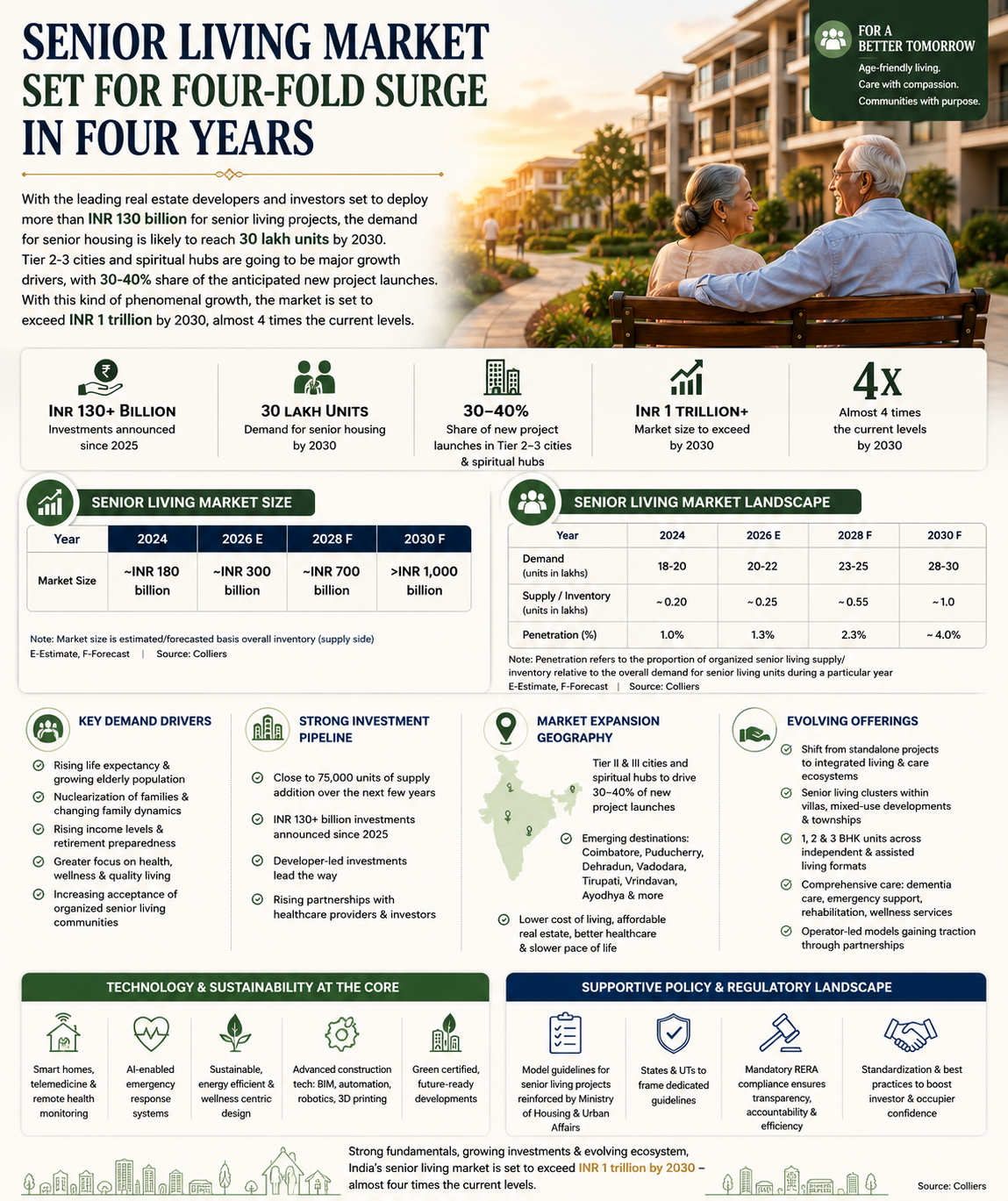
With the leading real estate developers and investors set deploy more than INR 130 billion for senior living projects , the demand for senior housing is likely to reach 30 lakh units by 2030. Tier 2-3 cities and spiritual hubs are going to be major growth drivers, with 30-40% share of the anticipated new project launches . With this kind of phenomenal growth, the market is set to exceed INR 1 trillion by 2030, almost 4 times the current levels.
Read More…
The senior living market in India has emerged as one of the most promising alternative real estate asset classes in the country supported by growing demand for age-focused housing and increasing participation from developers, healthcare operators and investors. While the segment is still at a nascent stage, it has evolved beyond conventional retirement housing to an organized market where senior housing is replete with health care facilities. India’s senior living market has seen strong traction in recent years with the segment currently standing at around INR 300 billion, almost 70% higher than 2024 levels.
Senior living market size
| Year | 2024 | 2026 E | 2028 F | 2030 F |
| Market size | ~INR 180 billion | ~INR 300 billion | ~INR 700 billion | >INR 1,000 billion |
Note: Market size is estimated/forecasted basis overall inventory (supply side) | E-Estimate, F-Forecast
Source: Colliers
Rising life expectancy, nuclearization of families, rising income levels, enhanced retirement preparedness with greater focus on health & wellness are driving demand for age-appropriate curated residential solutions. In fact, the share of India’s population aged 60 years and above is expected to rise to 21% by 2050 from 11% currently. Further, at over 0.3 billion, India is likely to account for about 16% of the 2.1 billion global elderly population (aged 60 years & above) by 2050, positioning it among the world’s key growth markets for senior housing.
According to Badal Yagnik, Chief Executive Officer & MD, Colliers India, on the supply side, India’s organized senior living inventory is expected to quadruple over the next 3-4 years Moreover, increasing policy support, growing investor participation and collaboration among leading developers & healthcare operators are likely to redefine senior living offerings across the country.Colliers estimates current senior living demand at around 20-22 lakh units while the inventory in the organized market is only around 25,000 units. This translates into a penetration rate of about 1.3%, highlighting significant headroom for future expansion.
With the elderly population (aged 60 years & above) projected to double from around 170 million currently to over 340 million by 2050, demand for senior living care is expected to witness a substantial increase over the coming decades. In fact, demand for senior living units is projected to reach nearly 30 lakh units by 2030, driven by increasing acceptance of organized senior living communities, rising life expectancy and growing preference for aged-focused housing & care-solutions. Meanwhile on the supply side, driven by aggressive expansion of leading operators & real estate developers, organized senior living inventory is set to scale up multi-fold times and reach around 1 lakh units by 2030, driving overall penetration levels to 4%.
Senior living market landscape
| Year | 2024 | 2026 E | 2028 F | 2030 F |
| Demand (units in lakhs) | 18-20 | 20-22 | 23-25 | 28-30 |
| Supply/inventory (units in lakhs) | ~ 0.20 | ~ 0.25 | ~ 0.55 | ~ 1.0 |
| Penetration (%) | 1.0% | 1.3% | 2.3% | ~ 4.0% |
Note: Penetration refers to the proportion of organized senior living supply/inventory relative to the overall demand for senior living units during a particular year | E-Estimate, F-Forecast : Colliers
India’s senior living segment is likely to see significant supply addition of close to 75,000 units over the next few years, supported by strong capital commitments from leading real estate developers, senior living operators and investors alike. Over INR 130 billion of investments have been announced since 2025 and are likely to be deployed towards development of senior living projects over the next 3-4 years. While developer-led investments continue to account for majority of the envisaged capital deployment, the segment is also witnessing rising traction in strategic partnerships with healthcare service providers. Interestingly, select institutional investors are increasingly forming joint venture platforms with leading real estate developers and are planning to aggressively expand their senior living footprint across key markets of the country.
Vimal Nadar, National Director & Research Head, Colliers India believes that the growing capital commitment towards senior living projects reflects the conviction of developers and investors in the segment’s long-term growth potential. With leading developers & operators announcing more than INR 130 billion investments since 2025, senior living projects are likely to witness acceleration in fund deployment over the course of next 3-4 years. The senior living market is set to witness a stronger development pipeline across categories including independent living & assisted living formats. Overall, these investments are set to strengthen operator offerings, enable expansion into newer markets and accelerate the segment’s transition towards a relatively mature real estate asset class.
Though the majority of India’s organized senior living stock currently exists in Tier-1 cities, the segment is gradually expanding into Tier II & III markets. Cities such as Coimbatore, Puducherry, Dehradun, Vadodara along with spiritual hubs like Tirupati, Vrindavan and Ayodhya are emerging as attractive destinations for senior housing due to evolving lifestyle preferences and cultural appeal. These locations offer a compelling value proposition in the form of lower cost of living, improving healthcare infrastructure, relatively affordable real estate price points and a slower pace of life in general. Looking ahead, as awareness and acceptance of senior living projects continue to grow and expand beyond Tier I cities, emerging Tier II/III cities are expected to account for a growing share of around 30-40% in new project launches and broaden the segment’s geographic footprint across the country.
India’s senior living landscape is witnessing a gradual shift from standalone developments to integrated living and care ecosystem. While in case of both independent & assisted living formats, 1,2 & 3 BHK configuration units continue to remain dominant, real estate developers are increasingly incorporating senior living clusters within villas, large mixed-use developments & integrated townships wherein senior residents can benefit from shared amenities, social interaction, healthcare access & community engagement. Going ahead, developers are likely to increasingly broaden their offerings and cater to diverse needs such as dementia care, emergency support, rehabilitation and wellness services. At the same time, operator-led models could gain further traction as leading real estate developers partner with local healthcare providers, unlocking investment opportunities in both established and emerging markets.
India’s senior living landscape is witnessing a gradual shift from standalone developments to integrated living and care ecosystem. While in case of both independent & assisted living formats, 1,2 & 3 BHK configuration units continue to remain dominant, real estate developers are increasingly incorporating senior living clusters within villas, large mixed-use developments & integrated townships wherein senior residents can benefit from shared amenities, social interaction, healthcare access & community engagement. Going ahead, developers are likely to increasingly broaden their offerings and cater to diverse needs such as dementia care, emergency support, rehabilitation and wellness services. At the same time, operator-led models could gain further traction as leading real estate developers partner with local healthcare providers, unlocking investment opportunities in both established and emerging markets.
The regulatory environment for senior living in India is expected to strengthen further in the coming years, following recent reinforcement of model guidelines for senior living projects, which were originally issued by the Ministry of Housing and Urban Affairs in 2019. This renewed emphasis is set to encourage states and union territories to develop guidelines that will strengthen the overall regulatory framework for senior housing in India. These guidelines along with mandatory Real Estate Regulatory Authority (RERA) compliance requirements will bring greater standardization, transparency, operational efficiency and accountability across senior living projects. Select states like Haryana and Maharashtra have already taken proactive steps towards establishing dedicated guidelines/policies for senior living projects, signalling the growing need for regulatory oversight in the segment.