Subtotal ₹0.00







Email :10
The Confederation of Real Estate Developers’ Associations of India has made a strong case for promoting ease of doing business by fast-tracking regulatory approvals including environmental clearances.
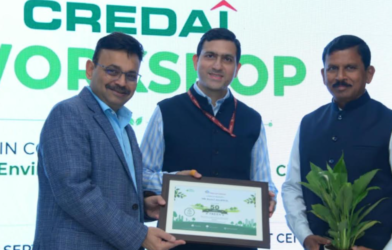
Credai made this strong plea following high level discussions held at a workshop in New Delhi. The discussions focused on reducing delays in the environmental clearance process, ensuring greater consistency in regulatory interpretation and simplifying approval procedures without compromising environmental compliance. The workshop was organised in collaboration with the Ministry of Environment, Forest and Climate Change (MoEFCC)and Central Pollution Control Board. It was attended by Credai President, Shekhar Patel, President Elect, G. Ram Reddy and Rajat Agarwal, Joint Secretary, Ministry of Environment, Forest & Climate Change.
Making a strong case for ease of doing business, CREDAI President Shekhar Patel said the real estate industry was not seeking any relaxation in environmental compliance or dilution of existing norms, but only a reduction in the time required to obtain Environmental Clearance (EC) approvals across the country. This will significantly contribute to improving the ease of doing business and enable the timely execution of real estate projects,.
The Environment Ministry on its part, clarified several provisions aimed at facilitating environmental approvals for the real estate sector. One of the key issues that came up during the deliberations was, the possibility of phase-wise Consent to Establish (CTE) for projects where the environmental clearance provides for phase-wise development. This would allow environmental consents to be aligned with the actual development schedule of a project. The CPCB also reiterated its policy direction to integrate CTE-related requirements with the EC application process. CREDAI emphasised the need for this integrated approach to be implemented uniformly across all states to avoid duplication and reduce parallel approval processes.
During discussions the need for greater uniformity in the interpretation and appraisal of EC applications by State Expert Appraisal Committees (SEACs) across states was also highlighted. CREDAI called for greater consistency in regulatory interpretation which would reduce uncertainty and improve predictability for developers operating across multiple jurisdictions. The Ministry also clarified that an amendment to an existing EC may not be required for certain changes to a project’s conceptual plan if such changes do not result in an increase in parameters such as built-up area or pollution load, subject to the conditions prescribed under the relevant Office Memorandum.
To ensure continuity in the appraisal of Category-B projects in cases where SEIAA or SEACs are non-functional, MoEFCC has provided for a Standing Authority and Standing Committee comprising senior government and technical officials. The arrangement is intended to ensure continuity in project appraisals until the respective bodies are reconstituted, for a defined period.Another key measure discussed was the introduction of a zero period for projects stalled due to proceedings before the National Company Law Tribunal (NCLT) or courts. The period during which such projects remain stalled would be excluded from the calculation of EC validity, helping avoid the need for de novo appraisal and facilitating the resumption of projects. The removal of the requirement for separate presentations before SEIAA after appraisal by SEAC also came up for discussion. The move is aimed at eliminating duplication and streamlining the approval process for Category-B projects.
To ensure continuity in the appraisal of Category-B projects in cases where SEIAA or SEACs are non-functional, MoEFCC has provided for a Standing Authority and Standing Committee comprising senior government and technical officials. The arrangement is intended to ensure continuity in project appraisals until the respective bodies are reconstituted, for a defined period.Another key measure discussed was the introduction of a zero period for projects stalled due to proceedings before the National Company Law Tribunal (NCLT) or courts. The period during which such projects remain stalled would be excluded from the calculation of EC validity, helping avoid the need for de novo appraisal and facilitating the resumption of projects. The removal of the requirement for separate presentations before SEIAA after appraisal by SEAC also came up for discussion. The move is aimed at eliminating duplication and streamlining the approval process for Category-B projects.
The Ministry also highlighted several other reforms aimed at reducing procedural complexity and improving regulatory predictability for the building sector. These include rationalisation of green-belt requirements, greater clarity on the transfer and amendment of Terms of Reference (ToR) and ECs, streamlined requirements for land-acquisition documents and technology-led reforms through the PARIVESH portal. Quarterly review meetings are held with SEACs to monitor the progress of applications and review approval timelines, with the objective of ensuring timely decisions across the country.
The Ministry also highlighted several other reforms aimed at reducing procedural complexity and improving regulatory predictability for the building sector. These include rationalisation of green-belt requirements, greater clarity on the transfer and amendment of Terms of Reference (ToR) and ECs, streamlined requirements for land-acquisition documents and technology-led reforms through the PARIVESH portal. Quarterly review meetings are held with SEACs to monitor the progress of applications and review approval timelines, with the objective of ensuring timely decisions across the country.