Subtotal ₹0.00






Maharashtra is entering a new phase of accelerated urban and economic development, with large-scale redevelopment, infrastructure expansion, new economic corridors and technology-led governance set to transform Mumbai and the wider metropolitan regions of the State, said Devendra Fadnavis, Chief Minister of Maharashtra.
The Chief Minister was speaking at the 6th Edition of Real Estate & Infrastructure Investors’ Summit – REIIS 2026, held in Mumbai on Thursday, where he outlined the State Government’s long-term development vision and invited the real estate and infrastructure industry to become a key partner in its execution.
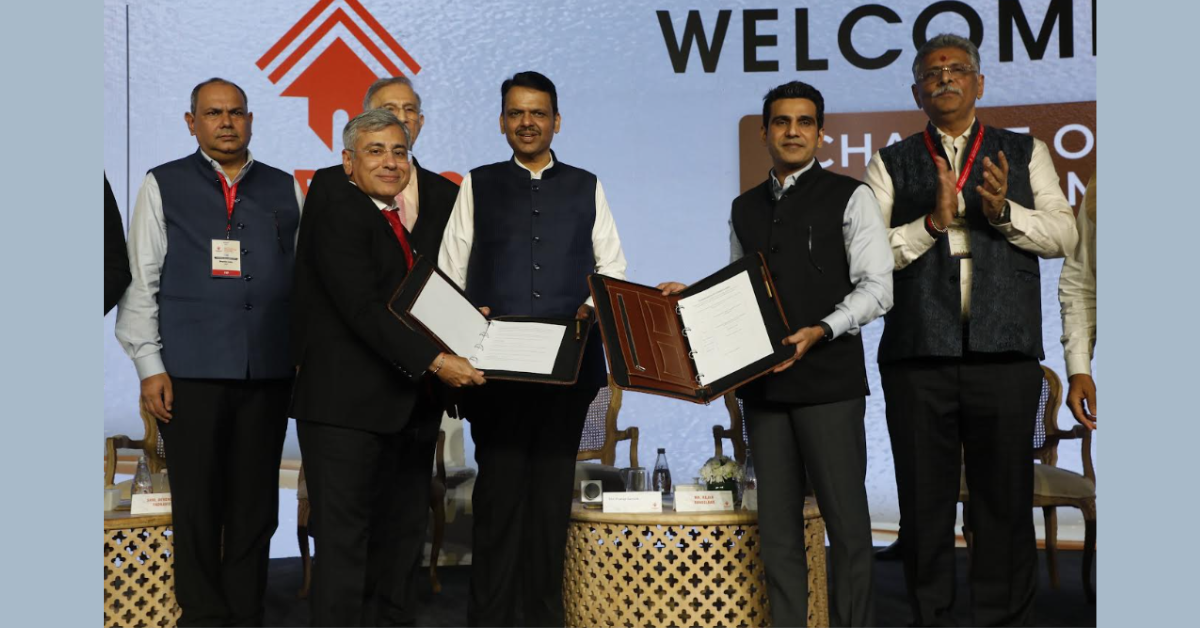
Fadnavis also unveiled the logo of ‘Naveen Nagpur’ (New Nagpur), the project initiated by NMRDA (Nagpur Metropolitan Regional Development Authority). NAREDCO Maharashtra signed a Memorandum Of Understanding (MoU) with NMRDA in the presence of Mr. Sanjay Meena, IAS, Metropolitan Commissioner, NMRDA.
Highlighting Maharashtra’s experience with regulation, the Chief Minister said, “Maharashtra was the first State to have a regulator. The Government worked with the developers’ fraternity and today Maharashtra has the most successful regulator in India. The trade has been cleaned up and a level playing field has been created,” he said.
According to the Chief Minister, the transformation taking place in the real estate sector is also reflected in the evolving functioning of industry associations such as NAREDCO, which are increasingly looking at the interests of the entire sector and its long-term growth.
Maharashtra grows at 8.8%; real estate emerges as a major growth engine
The Chief Minister pointed to Maharashtra’s strong economic performance, noting that while India recorded 7.6% growth in the first quarter, Maharashtra registered 8.8% growth. The real estate sector, he said, has an important role in sustaining this growth.
Noting that Mumbai’s property market is already reflecting this momentum with August 2026 recorded around 12,500 property registrations, the highest monthly number, while cumulative registrations crossed 1.06 lakh, generating approximately ₹9,355 crore in government revenue – a record performance, the Chief Minister said, “The real estate industry in MMR is growing at a fast pace. It is now time to give the entire Mumbai a new look”.
Redevelopment to become the new mantra for Mumbai
The Chief Minister identified redevelopment as one of the biggest opportunities for Mumbai’s next phase of transformation.
“With the Government’s cluster approach, in the next 10 years Mumbai will be slum-free. The roadmap is ready and efforts have started on the ground,” he said.
Talking about redevelopment of Dharavi, the Chief Minister informed that the Government’s objective is to have 10,000 rehabilitation homes ready by January 2029 and hand over the keys to eligible residents.
He said the cluster redevelopment approach would also unlock significant potential in old MHADA layouts and other ageing urban settlements developed several decades ago. “This opens up a huge scope for optimum utilisation of available land,” Fadanvis said.
BEST depots to be transformed into mixed-use urban destinations
The State Government is also planning comprehensive redevelopment of BEST depot lands, with the objective of combining transport infrastructure with mixed-use urban development.
The proposed developments could include residential and commercial spaces along with museums, recreational areas and other iconic public destinations.
Fadnavis said the model would help transform Mumbai’s urban landscape while creating a new revenue stream for BEST and strengthening the city’s public transport system.
He urged developers to actively participate in these opportunities.
MMR targeting a $1.5 trillion economy by 2047
Fadnavis said the ‘MMR Growth Plan’ has been designed with an ambitious long-term objective of taking the Mumbai Metropolitan Region’s economy to $1.5 trillion by 2047.
He emphasised that urbanisation has historically been at the heart of economic development and said Maharashtra is now pursuing planned urbanisation across the Mumbai, Pune and Nagpur metropolitan regions.
“These metropolitan regions will become the centres for 60% of India’s data-centre capacity and smart manufacturing,” he said, adding that over the next decade the metropolitan region would emerge as one of India’s most comprehensively planned and developed urban ecosystems.
“Mumbai 3.0 is not the future – it has already begun”
Fadnavis said the infrastructure projects that once formed the vision of Mumbai’s transformation including the coastal road, metro network and airport infrastructure have now moved from planning to delivery. “Mumbai 3.0 is not a future. It has already begun,” he said.
He pointed to the emergence of new urban centres, including Education Cities, Medi-cities and Innovation Cities, as the foundation for an entirely new and vibrant economic ecosystem.
Uttan-Virar sea link and third airport to open a new growth corridor
Looking ahead, Fadnavis outlined plans for a major expansion of Mumbai’s northern connectivity.
With the coastal road planned towards Virar, the State is working on a 24-km sea link from Uttan to Virar, which is envisaged to create signal-free connectivity from Nariman Point to Virar.
He also announced plans for a third airport for Mumbai in the Virar region, with the DPR expected to be ready by the end of 2026.
“This will create a new ecosystem for Mumbai 4.0 with improved connectivity,” he said.
Vadhavan Port to reshape India’s maritime economy
The Chief Minister described the upcoming Vadhavan Port as a transformational project for Maharashtra and India’s maritime ambitions.
He said JNPA currently handles around 75% of the relevant container traffic through the region, while Vadhavan is being developed with the ambition of becoming one of the world’s leading deep-draft ports and having significantly greater handling capacity.
The port is expected to generate large-scale employment and catalyse economic activity across Palghar and Thane districts.
The Chief Minister also outlined his vision for a dedicated freight corridor connecting the port towards Nashik and further through the Samruddhi Mahamarg towards Jalna, Wardha and dry ports up to Gadchiroli, thereby extending port-led economic activity to the interior parts of Maharashtra.
“Our dream is to create port connectivity to every corner of Maharashtra and bring the blue economy to the entire State,” he said.