Subtotal ₹0.00





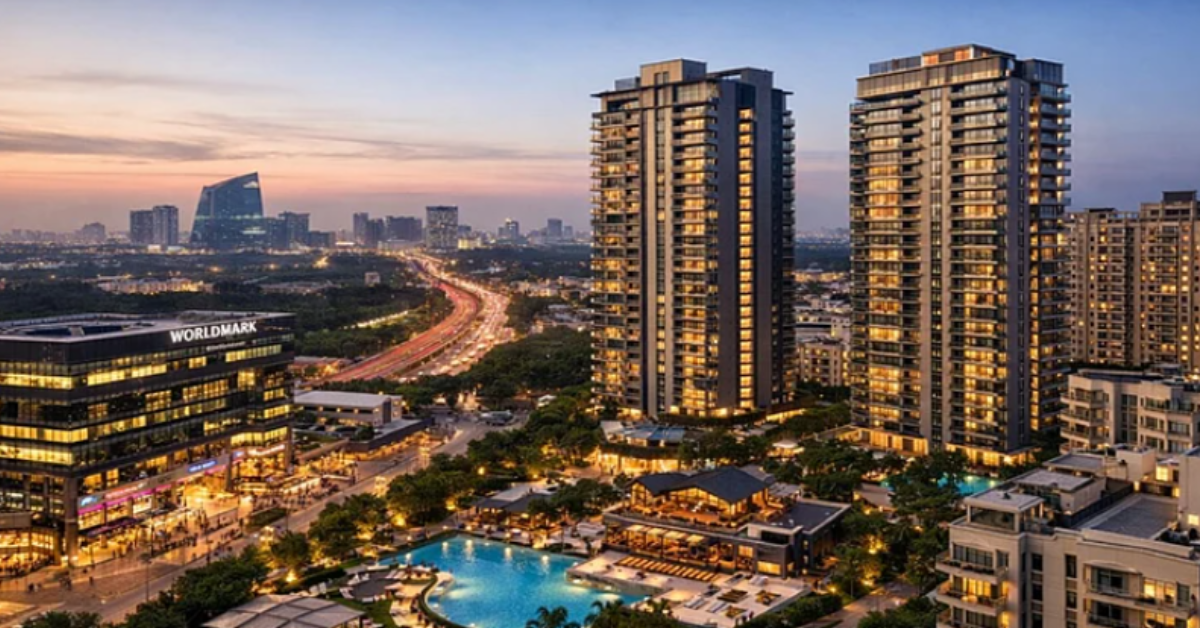

According to Knight Frank India, the residential market in the National Capital Region (NCR) in 2026 is shaped by lower launch volumes and a shift in new supply towards higher price brackets. NCR recorded housing sales of 35,574 units between January and September 2026 (9M CY2026[2]), down 11% from the same period a year ago. The decline reflects a sharp fall in new supply below INR 2 crore and a concentrated slowdown in Gurugram, rather than a broad-based weakening of demand. Outside Gurugram, NCR sales grew 3% over the same period. In the July to September quarter, sales stood at 10,712 units, the lowest quarterly level since 2021.
The market is increasingly defined by a mismatch in price segments and the location of new supply. Developers have moved new supply upmarket: launches below INR 2 crore have fallen by two-thirds since 2023, while those above INR 2 crores have risen 54%.
Geographically, the adjustment is concentrated in Gurugram. The city accounted for the majority of decline in NCR sales this year and holds 57% of the region’s unsold homes. The rest of NCR recorded 3% sales growth overall, with unsold stock nearly halved since 2021.
Mudassir Zaidi, Executive Director – North, Knight Frank India, said, “NCR’s residential market is undergoing a recalibration in its supply mix, rather than experiencing broad-based contraction in housing demand. The decline in overall sales is concentrated in the INR 5–10 crore segment and the Gurugram market, while demand in the INR 2–5 crore segment remains steady. The divergence between supply and demand highlights a clear opportunity for developers to calibrate new inventory more closely with the established buyer base below INR 2 crore. At the same time, infrastructure-led development is reshaping the region’s residential geography, with third-quarter launches concentrated along Sohna, the Dwarka Expressway, the NH-24 corridor in Ghaziabad and the Yamuna Expressway.”
A closer look by price bands shows that the NCR residential market is not under uniform pressure. Each segment is responding to a different mix of supply and demand dynamics.
Below INR 1 crores: Supply-constrained, not demand-constrained. Sales in this segment fell 29% to 5,386 units in January to September 2026 compared to the same period last year. But launches fell faster, down 47% to just 1,905 units.
INR 1 to 2 crores: The balanced core. Sales of 9,120 units were broadly in line with launches of 8,477 units, and both moved only marginally year-on-year (YoY). This remains NCR’s most stable segment.
INR 2 to 5 crores: Growing, but supply is running ahead. This is now NCR’s largest segment by both sales and launches. Sales rose 8% to 15,333 units, but launches rose faster, by 15% to 17,273 units. Developers appear to be adjusting launches in this band fell 46% quarter-on-quarter (QoQ) in Q3 2026.
INR 5 to 10 crores: The market’s stress point. Sales fell 39% YoY to 4,033 units, while launches of 5,002 units kept supply ahead of demand. The gap widened sharply in Q3: 2,346 units were launched against 925 sold.
Above INR 10 crore: Steady at the very top. Sales held broadly flat at 1,702 units for the year, and Q3 sales rose 39% year or year, albeit on a small base of 612 units. Developers have cut launches in this band by 40% this year.
Rising prices indicate demand remains supported
Weighted average prices increased YoY in every NCR market: 17% in Delhi, 14% in Ghaziabad, 11% in Greater Noida, 7% in Noida and Faridabad, and 4% in Gurugram. A demand-led slowdown would typically show falling prices, not rising ones.
Unsold stock remains stable
Sales exceeded launches in every quarter of 2026. NCR’s unsold inventory eased from 1,04,968 units at the end of 2025 to 1,03,342 units at the end of 2025 to 1,03,342 units by September 2026. Unsold stock outside Gurugram has nearly halved since early 2021, from 83,579 to 43,978 units.