Subtotal ₹0.00







Email :172
By Aditya Chellaram
The way office space is being looked at in India today feels very different from even a few years ago. There’s been a clear shift in how office space is being evaluated across India.
Not too long ago, most decisions came down to location, rental, and how efficiently a floor plate could be filled. Today, that equation feels incomplete. Conversations with occupiers, especially larger global teams, are starting at a very different place. The first filter is no longer just where the building sits, but how the space will actually work once people step into it.
If we look at how office space is being evaluated today, it’s clearly not the same as before. As per a report by CBRE, India’s office market has come back strongly over the last two years, with annual leasing volumes in the range of 55–60 million sq ft. Bengaluru alone continues to account for roughly a quarter of that demand, which indicates that this is not a shrinking market. The real shift is in expectations, and they’ve become far more demanding than before. What used to be acceptable even five years ago is now getting filtered out very quickly.
A big driver behind this shift has been the growing influence of global capability centres. Today, GCCs account for anywhere between 35 to 45 percent of total office leasing across major cities. These are not companies that are experimenting with workplace standards. They come with clearly defined expectations on how space should perform, not just how it should look. For them, the office is tied closely to talent retention, productivity, and culture. That changes the conversation at the design stage itself. This is where Design thinking has quietly moved from being a backend function to something far more central. Not in the superficial sense of finishes or façade, but in how the space is planned, how people move through it, and how different teams interact within it.
Most buildings in the earlier cycle were built around density. The idea was simple: maximise usable area, increase seat count, and keep costs under control. That logic starts to break down when the office is no longer occupied in the same way.
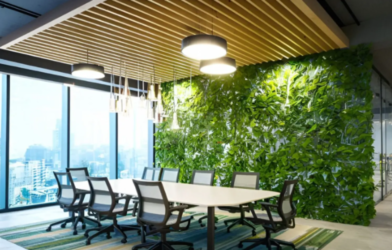
Hybrid work has played a role here, but not in the way it is often described. It hasn’t reduced the need for office space as much as it has exposed its limitations. When people are not coming in five days a week, the purpose of the office has to be clearer. It has to offer something that a remote setup cannot. That has led to a visible shift in how space is being allocated. There is less emphasis on rows of workstations and more on collaboration zones, informal meeting areas, and spaces that support longer, more meaningful interactions.
This change is also showing up in leasing behaviour. There is a clear flight to better-quality buildings. As per a report by Knight Frank, Grade A developments with stronger design fundamentals are seeing higher occupancy and, in many cases, a rental premium of 10 to 20 percent over average stock in the same micro-market. At the same time, older buildings that were designed for a different era are finding it harder to stay relevant. Vacancy in such assets is not just a function of location or pricing anymore. It is increasingly a reflection of how well the building adapts to current workplace needs.
What is interesting is that Design is now influencing decisions much earlier in the process. Earlier, a tenant would take up space and then invest heavily in interiors to make it work. Today, many of those decisions are being evaluated before the lease is even signed. Floor plate efficiency, access to natural light, ceiling heights, core placement, and the ability to create flexible layouts are all being assessed upfront. In a way, the base building itself is expected to do a lot more of the heavy lifting.
This is also where the gap between developers is becoming more visible. There are still projects that are built as standard office blocks, where design is layered on later. And then there are developments where the planning starts with how the end user will experience the space on a daily basis. The difference between the two is not always obvious in a brochure, but it becomes very clear once the building is operational.
Sustainability and wellness have added another layer to this conversation. Certifications are one part of it, but occupiers are looking beyond labels. Air quality, daylight access, energy efficiency, and overall comfort levels are now being discussed in measurable terms. These are not add-ons anymore. They are becoming part of the baseline expectation, especially for companies that are aligning their workplace strategies with larger ESG goals.
All of this points to a larger shift in how commercial real estate is being understood. The office is no longer just a physical asset that gets leased out. It has become a tool that influences how organisations function. Design, in that sense, is not about differentiation in the traditional marketing sense. It is about whether the space actually delivers on what the occupier needs it to do.
Over the next few years, this gap is only going to widen. Buildings that are able to respond to these expectations will continue to attract stronger demand. Those that don’t will find it increasingly difficult to compete, regardless of where they are located. In many ways, the market has already started making that distinction. Design is simply making it visible.
(The author is Executive Director at Featherlite Developers. Views are personal)