Subtotal ₹0.00






Email :82
The year 2026 has started on a high note for residential society redevelopment activity, signalling a structural transition from fragmented building level redevelopment to larger cluster-led projects, marking neighbourhood -scale urban renewal in suburban Mumbai.
That residential redevelopment is on an upswing, is clearly evident from the significant increase in the number of developer agreements (DAs) signed during the first quarter of 2026. Nearly 70 developer agreements (DAs) signed within the first 90 days of the year, accounting for over 30% of the total agreements recorded during full-year 2025.
The market has remained resilient despite the ongoing geopolitical tensions in West Asia and evolving global uncertainties. With a population density of nearly 30,600 persons per sq km, significantly higher than global urban centres such as Tokyo, New York City and Singapore, redevelopment continues to remain a critical housing supply mechanism for the city. According to a recent study by Knight Frank India, nearly 70 developer agreements (DAs) were signed within first quarter of 2026. Considering the rising scale of redevelopment, Mumbai’s redevelopment pipeline may well unlock nearly 59k new homes valued at INR 1500 billion by 2031, reaffirming redevelopment as one of the key drivers of city’s future housing supply.
Mumbai’s redevelopment momentum continues to strengthen amid rising urban density and an ageing housing stock across the city. According to the Brihanmumbai Municipal Corporation (BMC)’s 2017 Audit report, 1.6 lakh buildings in Mumbai are over 30 years old and have been identified for structural audits, with the highest concentration located in the Western Suburbs (46%), followed by the Island City (28%) and Eastern Suburbs (26%).
Reflecting the growing urgency for redevelopment, developer agreements in Mumbai crossed the 1,050 mark for the first time since 2020, with 1,094 societies currently under redevelopment, collectively unlocking nearly 432 acres of land across the city. As of March 15, 2026, around 70 societies covering nearly 52.2 acres had already entered redevelopment, compared to 196 societies spanning 101.3 acres in 2024 and 229 societies covering 104.8 acres in 2025. The early momentum indicates sustained developer appetite and continued acceleration in redevelopment activity across the city. The redevelopment activity accounted for nearly 8% Mumbai’s rental demandof March 2026.
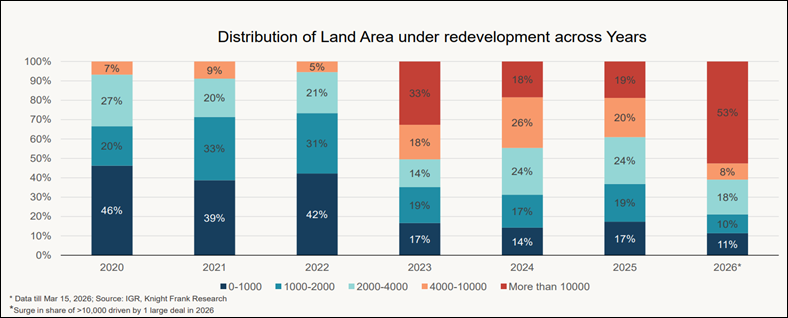
There is a gradual shift in redevelopment activity towards larger land parcels, with projects exceeding 10,000 sq m gaining traction following key policy reforms such as DCPR 2034 and the Self-Redevelopment Policy. While redevelopment activity in this category remained limited between 2020 and 2022, larger-format projects have witnessed an uptick in recent years, with land parcels above 10,000 sq m accounting for more than half of the total redevelopment area in 2026. This trend signals a gradual transition from fragmented society-level redevelopment towards more organised, cluster-led urban renewal across Mumbai, supported by improved land aggregation, stronger project viability and enhanced redevelopment economics.
Redevelopment, according to Shishir Baijal, Chairman & Managing Director, Knight frank India, is expected to remain central to Mumbai’s long-term urban growth strategy, particularly as land scarcity and ageing housing stock continue to limit greenfield expansion opportunities. The increasing scale of projects and rising traction across suburban micro-markets, indicate that the sector is evolving into a more organised and economically viable development model. Going forward, redevelopment is likely to play a critical role not only in augmenting housing supply, but also in supporting infrastructure-led urban renewal and improving the quality of residential stock across the city. Western suburbs led the redevelopment activity with 773 societies under redevelopment followed by central suburbs with 261 societies. Collectively, suburban Mumbai attributed to 95% of redevelopment activity.
Top-10 Society Redevelopment Hotspots
| Rank | Location | Society Count |
| 1 | Borivali | 220 |
| 2 | Andheri | 115 |
| 3 | Bandra | 75 |
| 4 | Malad | 68 |
| 5 | Ghatkopar | 59 |
| 6 | Kandivali | 58 |
| 7 | Vile Parle | 57 |
| 8 | Goregaon | 49 |
| 9 | Chembur | 48 |
| 10 | Mulund | 46 |
Source: Knight Frank
Since 2020, developer agreements under Mumbai’s society redevelopment programme have accelerated significantly across suburban localities, with Borivali leading the charge at 220 agreements, followed by Andheri and Bandra with 115 and 75 agreements respectively, taking the total number of societies under redevelopment to 1,094. This geographically diversified pipeline, spanning established western corridors such as Malad, Kandivali and Goregaon, along with emerging nodes including Chembur, Mulund and Vikhroli, highlights how cluster-friendly plot sizes and sustained residential demand continue to drive developer interest. The depth of activity across both established premium locations such as Santacruz, Juhu and Bandra, and emerging redevelopment belts like Borivali, Malad and Goregaon, indicates that redevelopment momentum remains broad-based across the city, with suburban markets continuing to account for a dominant share of the pipeline.
Mumbai’s redevelopment market, as per Ghulam Zia, International Partner, Senior Executive Director, Research, Advisory, Infrastructure & Valuation, Knight Frank India, is increasingly being shaped by robust housing and sustained activity across micro-markets. Mumbai’s redevelopment pipeline could unlock nearly 59,000 new homes worth approximately INR 1,500 bn by 2031. Locations such as Borivali, Andheri, Bandra, and Ghatkopar continue to attract redevelopment interest due to their established residential ecosystems and strong occupier demand. At the same time, the spread of redevelopment activity across these micro-markets suggests that demand is becoming more diversified and structurally resilient, reinforcing its importance within Mumbai’s broader housing market.